from google alerts...
In the Sydney Morning Herald of April 22, 2012 there is an article called Last Man Standing, which is about the author Ian W. Shaw and his new book "Glenrowan: The Siege that Shaped a Nation."
The article begins with:
There have probably been more films, plays, songs, nonfiction books and novels written about Ned Kelly than any other Australian in history.
So why would a Canberra civil servant who works in the federal Attorney-General's office think we needed another volume about the country's most famous criminal?
''I've always been intrigued by Ned Kelly,'' says Ian W. Shaw, 61.
''Not Kelly himself so much as the siege at Glenrowan."
''Everyone knows a little bit about the siege but no one ever seems to know the full story....''
Read more: http://www.smh.com.au/entertainment/books/last-man-standing-20120421-1xd9n.html#ixzz1shnHiv9o
(I beg to differ on the bit that says "no one ever seems to know the full story" as there are quite a few of us out here that have made the siege somewhat of a focal point of our long-term studies and have accessed much of the research/archival material he talks about in the article. But, yes, admittedly, there are many who will be very well served by the book to educate them on the finer points of the Kelly Gang's Siege of the Glenrowan.)

WELCOME TO ELEVEN MILE CREEK. Thanks for visiting us. We hope to use this blog to bring news, views, nuggets and musings, some serious, some lighthearted, but all to do with all things associated with Ned Kelly.
Saturday, April 21, 2012

Sunday, April 15, 2012
I got a mention in the bibliography of the new "Glenrowan" book!
Back at the end of 2011, after being tipped off by Michael Ball, I had reported that a new book called "Glenrowan: The Siege That Shaped a Nation" by Ian W. Shaw was to be released on April 1, 2012. I have not yet gotten a copy, but Mark Perry did and he told me that I got a mention in the bibliography of it! I was very gratified to see that someone appreciates my research and found it to be of use. Michael Ball was kind enough to scan it in for me and here it is:

It was for my article on Jane Jones I did for the nedonthenet and glenrowan1880 sites. I had written it back in 2010 (not 2007) and if anyone wishes to read it they can go to either of the links provided below to do so. Seems that it is not available on the sitemap or menus at either site, nor are any of my other View From Abroad articles that this was a part of, but is still findable for now under google. I suppose when, or if, they cease to be found at all I can perhaps eventually add the best of them to this blog for archival purposes.
www.nedonthenet.com/Jane.htm
www.glenrowan1880.com/Jane.htm

It was for my article on Jane Jones I did for the nedonthenet and glenrowan1880 sites. I had written it back in 2010 (not 2007) and if anyone wishes to read it they can go to either of the links provided below to do so. Seems that it is not available on the sitemap or menus at either site, nor are any of my other View From Abroad articles that this was a part of, but is still findable for now under google. I suppose when, or if, they cease to be found at all I can perhaps eventually add the best of them to this blog for archival purposes.
www.nedonthenet.com/Jane.htm
www.glenrowan1880.com/Jane.htm
Tuesday, April 10, 2012
My Review of Encounters With the Kellys [Sharon Hollingsworth]
Recently I did a book alert about "Encounters With the Kellys: A Plea for Freedom from Dan and Ned Kelly" by Delta Shannon in which I said I was going to order it. It has arrived and I have had a chance to read it and would like to give a review of it here after I put the synopsis/blurb for it from the publisher's website that I had put in the previous alert (just to refresh everyone's memories):
“I first met Dan Kelly in a museum gift shop …”
So begins Delta Shannon’s journey of discovery with Dan and Ned Kelly. For five years after that first meeting with Dan, her life would be consumed by the Kellys, as she channelled their spirits. Together, they now work to share this message, as well as the truth about the Siege at Glenrowan, with the public.
Dan and Ned Kelly speak here, to and through Shannon. They want people to know that their spirits are earthbound, that they are restless and angry, and that they no longer wish to be bound to this plane. Somewhat ironically, it is the iconization of their name and legacy (not to mention the merchandising of the Kelly name) that keep them from achieving peace, and they want it to stop.
The people of Australia can release Dan and Ned and allow them to go beyond the higher realms and heal their souls. In Encounters with the Kellys, Shannon lets the men share their side of the story and shares how modern-day readers can help these two trapped souls find rest.
Their message is clear: They are lost. They are in pain. They want to be free.
Go to the link below and click on "Free Preview" to read the introduction to the book that gives so much more.
http://bookstore.balboapress.com/Products/SKU-000468516/Encounters-with-the-Kellys.aspx
Ok, let me start off the review by saying that this book might not be for everyone. I know that some out there will think this book is maybe all just baloney, or a scam/hoax, or a product of someone's overactive imagination or what have you. Maybe these scoffers/unbelievers should not bother with it if it will annoy them that much (or maybe they should give it a chance to change their outlook?). But to others with an open mind and open heart to the things of this world and beyond, then this book and its message may resonate with you.
The book is a slim one with around 76 pages (the first section is Roman numeralized). The text covers 39 pages with the final pages (40-63) showing the actual images of some of the automatic spirit writing that is transcribed in the first part.
Both Dan and Ned Kelly have their say, so to speak, about many things through the author Delta Shannon in this book (she has "As channelled by Delta Shannon" on the title page). A couple of the things regarding the death of John 'Red' Kelly and something that they allege happened to their mother at the hands of the Victorian police gives me a bit of a pause, but sometimes things are open to different interpretations, so I just went forward past all that.
Moving on there are very many things in this book that are heart wrenching and thought provoking. If you have gone and read the introduction to the book at the Balboa Publishing site linked above you will have an idea of what the book contains and what the tone is. I was very interested to hear that Dan Kelly wants the whole family buried together, that no one escaped to Queensland (as many of us have always said!) and that it was he, Dan, who did not trust Steve Hart, not Ned like has been said elsewhere. Dan weighed in about the archaeological diggings in Glenrowan and in particular about the finding of a certain bullet and how he is "sick of the 'so-called legend' being kept alive for the sake of making money and Australian tourism." I also found of interest Ned's take on how the Victorian police were always targeting them even before the formation of the Kelly gang and about the English vs Irish type of racism they suffered under. Ned told how he kept many things back from his brother Dan who he claimed was a "worrier" and he says that "my spirit needs to be released, and all the while they keep rehashing the past and keeping the lie alive, I cannot and am unable to rest in peace, or Dan for that matter."
Dan Kelly had the most plaintive plea:
"People nowadays keep the legend alive by putting us down continually. Please, I ask, let it go so we can be released. It's forgiveness that we seek, and understanding.......Recognise us for what we were; not villains and thieves, but martyrs and soul men, loving the animals and the bush. Why were we not just left alone? My soul will never rest in peace until this becomes such. To be at peace with one's self is to recognise the truth, and as the superficial tourists know not what this means, I wish to make it quite clear to leave us alone and continue no more to rape the Kellys' name of their dignity and pride..."
I am glad that I discovered this unique little book, it gives one much to ponder on!
“I first met Dan Kelly in a museum gift shop …”
So begins Delta Shannon’s journey of discovery with Dan and Ned Kelly. For five years after that first meeting with Dan, her life would be consumed by the Kellys, as she channelled their spirits. Together, they now work to share this message, as well as the truth about the Siege at Glenrowan, with the public.
Dan and Ned Kelly speak here, to and through Shannon. They want people to know that their spirits are earthbound, that they are restless and angry, and that they no longer wish to be bound to this plane. Somewhat ironically, it is the iconization of their name and legacy (not to mention the merchandising of the Kelly name) that keep them from achieving peace, and they want it to stop.
The people of Australia can release Dan and Ned and allow them to go beyond the higher realms and heal their souls. In Encounters with the Kellys, Shannon lets the men share their side of the story and shares how modern-day readers can help these two trapped souls find rest.
Their message is clear: They are lost. They are in pain. They want to be free.
Go to the link below and click on "Free Preview" to read the introduction to the book that gives so much more.
http://bookstore.balboapress.com/Products/SKU-000468516/Encounters-with-the-Kellys.aspx
Ok, let me start off the review by saying that this book might not be for everyone. I know that some out there will think this book is maybe all just baloney, or a scam/hoax, or a product of someone's overactive imagination or what have you. Maybe these scoffers/unbelievers should not bother with it if it will annoy them that much (or maybe they should give it a chance to change their outlook?). But to others with an open mind and open heart to the things of this world and beyond, then this book and its message may resonate with you.
The book is a slim one with around 76 pages (the first section is Roman numeralized). The text covers 39 pages with the final pages (40-63) showing the actual images of some of the automatic spirit writing that is transcribed in the first part.
Both Dan and Ned Kelly have their say, so to speak, about many things through the author Delta Shannon in this book (she has "As channelled by Delta Shannon" on the title page). A couple of the things regarding the death of John 'Red' Kelly and something that they allege happened to their mother at the hands of the Victorian police gives me a bit of a pause, but sometimes things are open to different interpretations, so I just went forward past all that.
Moving on there are very many things in this book that are heart wrenching and thought provoking. If you have gone and read the introduction to the book at the Balboa Publishing site linked above you will have an idea of what the book contains and what the tone is. I was very interested to hear that Dan Kelly wants the whole family buried together, that no one escaped to Queensland (as many of us have always said!) and that it was he, Dan, who did not trust Steve Hart, not Ned like has been said elsewhere. Dan weighed in about the archaeological diggings in Glenrowan and in particular about the finding of a certain bullet and how he is "sick of the 'so-called legend' being kept alive for the sake of making money and Australian tourism." I also found of interest Ned's take on how the Victorian police were always targeting them even before the formation of the Kelly gang and about the English vs Irish type of racism they suffered under. Ned told how he kept many things back from his brother Dan who he claimed was a "worrier" and he says that "my spirit needs to be released, and all the while they keep rehashing the past and keeping the lie alive, I cannot and am unable to rest in peace, or Dan for that matter."
Dan Kelly had the most plaintive plea:
"People nowadays keep the legend alive by putting us down continually. Please, I ask, let it go so we can be released. It's forgiveness that we seek, and understanding.......Recognise us for what we were; not villains and thieves, but martyrs and soul men, loving the animals and the bush. Why were we not just left alone? My soul will never rest in peace until this becomes such. To be at peace with one's self is to recognise the truth, and as the superficial tourists know not what this means, I wish to make it quite clear to leave us alone and continue no more to rape the Kellys' name of their dignity and pride..."
I am glad that I discovered this unique little book, it gives one much to ponder on!
Friday, April 6, 2012
Article Alert: Ned Kelly's Remains Still in Limbo
from google alerts..
In the Herald Sun of April 6, 2012 there is an article called Kelly's Remains Still in Limbo.
Excerpt from the article:
...The bushranger's remains were formally identified last year, and the State Government decided to give them to his family.
RMIT adjunct professor Peter Norden, a former Pentridge chaplain, said the developer was holding up the process.
Prof Norden urged the Baillieu Government to ensure the remains were given to Kelly's family.
The Victorian Institute of Forensic Medicine identified the remains last year using the DNA of a family member.
Attorney-General Robert Clark subsequently decided that the remains would be given to Kelly's family.
A source familiar with the issue said the developer wanted to keep the remains, possibly as a feature for the development.
The issue has become complicated because the exhumation certificate indicated that the remains would be returned to Pentridge. The source said the developer has indicated he was considering legal action.....
To read more (you must sign up to do so):
http://www.heraldsun.com.au/news/more-news/ned-kelly-is-still-not-buried/story-fn7x8me2-1226320135936
In the Herald Sun of April 6, 2012 there is an article called Kelly's Remains Still in Limbo.
Excerpt from the article:
...The bushranger's remains were formally identified last year, and the State Government decided to give them to his family.
RMIT adjunct professor Peter Norden, a former Pentridge chaplain, said the developer was holding up the process.
Prof Norden urged the Baillieu Government to ensure the remains were given to Kelly's family.
The Victorian Institute of Forensic Medicine identified the remains last year using the DNA of a family member.
Attorney-General Robert Clark subsequently decided that the remains would be given to Kelly's family.
A source familiar with the issue said the developer wanted to keep the remains, possibly as a feature for the development.
The issue has become complicated because the exhumation certificate indicated that the remains would be returned to Pentridge. The source said the developer has indicated he was considering legal action.....
To read more (you must sign up to do so):
http://www.heraldsun.com.au/news/more-news/ned-kelly-is-still-not-buried/story-fn7x8me2-1226320135936
Friday, March 30, 2012
New Book Alert: Encounters with the Kellys: A Plea for Freedom from Dan and Ned Kelly written by Delta Shannon
While searching on the net for information on another book on the Kellys I stumbled across this fascinating new one on offer that none of the other Kelly sites seem to have reported on yet - Encounters with the Kellys: A Plea for Freedom from Dan and Ned Kelly - by Delta Shannon, released by Balboa Press in February of 2012.
The synopsis/blurb for it from Balboa's website:
“I first met Dan Kelly in a museum gift shop …”
So begins Delta Shannon’s journey of discovery with Dan and Ned Kelly. For five years after that first meeting with Dan, her life would be consumed by the Kellys, as she channelled their spirits. Together, they now work to share this message, as well as the truth about the Siege at Glenrowan, with the public.
Dan and Ned Kelly speak here, to and through Shannon. They want people to know that their spirits are earthbound, that they are restless and angry, and that they no longer wish to be bound to this plane. Somewhat ironically, it is the iconization of their name and legacy (not to mention the merchandising of the Kelly name) that keep them from achieving peace, and they want it to stop.
The people of Australia can release Dan and Ned and allow them to go beyond the higher realms and heal their souls. In Encounters with the Kellys, Shannon lets the men share their side of the story and shares how modern-day readers can help these two trapped souls find rest.
Their message is clear: They are lost. They are in pain. They want to be free.
Go to the link below and click on "Free Preview" for the introduction to the book. It will give you goosebumps, particularly where it says that Dan Kelly's spirit was quite upset over the recent archaeological diggings in Glenrowan and that he wanted the photo of his charred remains removed from the museum gift shop!
http://bookstore.balboapress.com/Products/SKU-000468516/Encounters-with-the-Kellys.aspx
I fully intend to get my hands on a copy of this as soon as possible!
The synopsis/blurb for it from Balboa's website:
“I first met Dan Kelly in a museum gift shop …”
So begins Delta Shannon’s journey of discovery with Dan and Ned Kelly. For five years after that first meeting with Dan, her life would be consumed by the Kellys, as she channelled their spirits. Together, they now work to share this message, as well as the truth about the Siege at Glenrowan, with the public.
Dan and Ned Kelly speak here, to and through Shannon. They want people to know that their spirits are earthbound, that they are restless and angry, and that they no longer wish to be bound to this plane. Somewhat ironically, it is the iconization of their name and legacy (not to mention the merchandising of the Kelly name) that keep them from achieving peace, and they want it to stop.
The people of Australia can release Dan and Ned and allow them to go beyond the higher realms and heal their souls. In Encounters with the Kellys, Shannon lets the men share their side of the story and shares how modern-day readers can help these two trapped souls find rest.
Their message is clear: They are lost. They are in pain. They want to be free.
Go to the link below and click on "Free Preview" for the introduction to the book. It will give you goosebumps, particularly where it says that Dan Kelly's spirit was quite upset over the recent archaeological diggings in Glenrowan and that he wanted the photo of his charred remains removed from the museum gift shop!
http://bookstore.balboapress.com/Products/SKU-000468516/Encounters-with-the-Kellys.aspx
I fully intend to get my hands on a copy of this as soon as possible!
Sunday, March 25, 2012
Article Alert: Kelly Clan Gathering to Hear of Genetic Links to Australian Outlaw Ned Kelly
from Google alerts..
The Irish Times of March 26, 2012 has an article called Kelly Clan Gathering to Hear of Genetic Links to Australian Outlaw Ned Kelly.
Excerpts from the article:
The genetic links of one of Australia’s most notorious and controversial outlaws – Ned Kelly – will be the focus of the next Kelly clan gathering in Dundrum, Co Tipperary, in May.
Key speaker at the May 17th- 19th gathering will be Australian Aidan Kelly, the clan’s chief recorder on genetic genealogy, who will be presenting the latest analysis of the Kelly Y-DNA study (the genetic links of the male line).
To read more:
http://www.irishtimes.com/newspaper/ireland/2012/0326/1224313895543.html
The Irish Times of March 26, 2012 has an article called Kelly Clan Gathering to Hear of Genetic Links to Australian Outlaw Ned Kelly.
Excerpts from the article:
The genetic links of one of Australia’s most notorious and controversial outlaws – Ned Kelly – will be the focus of the next Kelly clan gathering in Dundrum, Co Tipperary, in May.
Key speaker at the May 17th- 19th gathering will be Australian Aidan Kelly, the clan’s chief recorder on genetic genealogy, who will be presenting the latest analysis of the Kelly Y-DNA study (the genetic links of the male line).
To read more:
http://www.irishtimes.com/newspaper/ireland/2012/0326/1224313895543.html
Article Alert: Ned's Last Stand Not a Solo Affair (newspaper review of Ian W. Shaw's new book Glenrowan)
The Australian of March 24, 2012 had an article entitled Ned's Last Stand Not a Solo Affair by Tom Gilling in which Ian W. Shaw's upcoming book Glenrowan: The Legend of Ned Kelly and the Siege that Shaped a Nation is reviewed.
An excerpt:
Shaw does an expert job of depicting the siege not just as the
culmination of Kelly's outlaw career, but as an event that altered the
lives of dozens of ordinary people who happened to be in Glenrowan on
the day the Kelly gang rode into town. He digs deeper than other
authors into the tensions and rivalries that existed among the police
rank and file. In remote country areas law and order rested on the
actions of individual police, so Shaw's meticulous account of what
happened in the police lines as they waited nervously for the final
shootout sheds useful light on some of the broader issues surrounding
Kelly's years as an outlaw.
But it comes at a price. By concentrating, in sometimes pedantic
detail, on exactly who did what, where they stood and what weapon they
were holding, whether they were cowering in the kitchen or the
bedroom, Shaw risks diminishing the very thing that makes the Kelly
story so captivating, namely Kelly. There are times in the book when
he seems almost a peripheral character while his namesake, senior
constable John Kelly, takes centre stage.
The end of the review says:
Literally, Shaw may be right to say that Glenrowan "is about Ned and
Charles and all the others who were there", but this ignores the fact
that without Ned there would have been no Glenrowan. Someone else,
more or less brave than Charles Johnston, could always have been found
to set fire to the inn after Ned had been shot down. The author who
sees no difference between Ned staggering out of the mist in his
inadequate home-made armour and Johnston skulking with his kerosene
and matches has perhaps missed the point of the story.
Tuesday, March 13, 2012
Article Alert: New Hare Letter Added to University of Melbourne Archives
From google alerts:
The University of Melbourne has acquired a new Superintendent Francis Hare letter regarding the capture of the Kelly Gang which will be added to their Archives.
See here for more info:
http://blogs.unimelb.edu.au/librarycollections/2012/03/13/ned-kelly-goes-online/
Go here for a larger image of one side of the letter:
http://blogs.unimelb.edu.au/librarycollections/files/2012/03/Hare-letter-portrait.-Backlit.jpg
You may recall that this is the same letter that was recently found and subsequently bound for auction.
See here for more:
http://elevenmilecreek.blogspot.com/2011/12/article-alert-family-album-reveals.html
Even more background on the letter can be found here:
http://www.treloars.com/auction3/node/603
The University of Melbourne has acquired a new Superintendent Francis Hare letter regarding the capture of the Kelly Gang which will be added to their Archives.
See here for more info:
http://blogs.unimelb.edu.au/librarycollections/2012/03/13/ned-kelly-goes-online/
Go here for a larger image of one side of the letter:
http://blogs.unimelb.edu.au/librarycollections/files/2012/03/Hare-letter-portrait.-Backlit.jpg
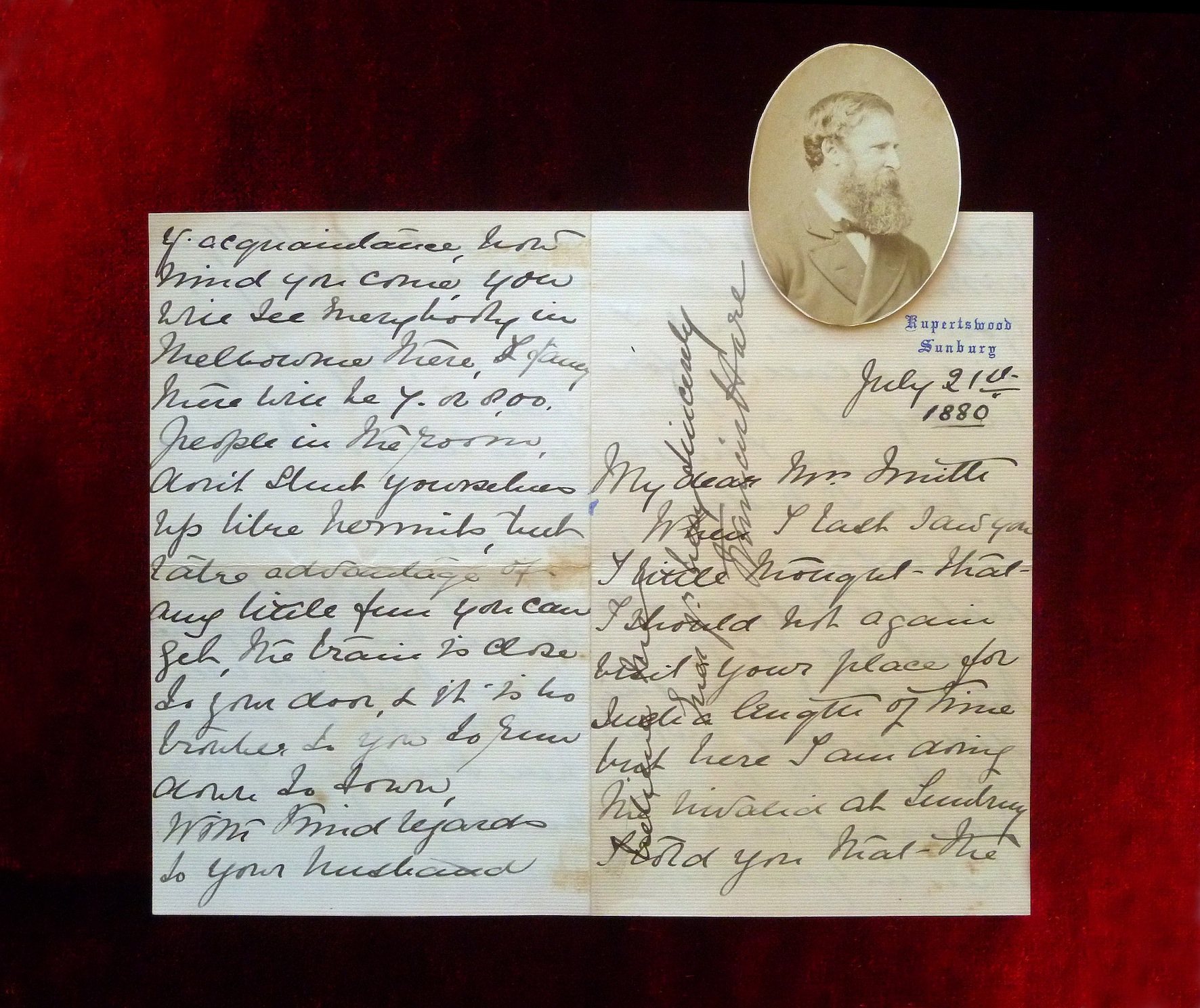
You may recall that this is the same letter that was recently found and subsequently bound for auction.
See here for more:
http://elevenmilecreek.blogspot.com/2011/12/article-alert-family-album-reveals.html
Even more background on the letter can be found here:
http://www.treloars.com/auction3/node/603
Wednesday, March 7, 2012
Part 2: Calling for a Cannon and Asking for a Light [Sharon Hollingsworth]
Before I continue on with information about the cannon that Superintendent Sadleir called for, I want to reiterate a little of what I had written in In Part 1 of Calling for a Cannon and Asking for a Light.
I started off with the following few paragraphs...
The Siege of Glenrowan came to an end around 3 PM on June 28, 1880. Joe Byrne was laying dead inside the Glenrowan Inn and Ned Kelly had been captured early that morning, leaving Kelly Gang members Steve Hart and Dan Kelly inside with dozens of policemen surrounding the building. The police feared that the two desperate - and now leaderless - young men would somehow attempt to escape under cover of the night if the siege were to last into the evening, so Superintendent Sadleir ordered a cannon to be sent up from Melbourne to blow the house down around them. Meanwhile, the Chief Secretary in Melbourne had consulted with Robert Ellery, the Government Astronomer about getting an electric light apparatus sent to Glenrowan so that the aforementioned escape fear would not eventuate.
Seems that fate took a hand, in the person of Senior-Constable Charles Johnston, so that neither of those two devices would be needed.
Here is part of what Senior-Constable Charles Johnston said before the Royal Commission in 1881:
7159. Were you present when the proposal was made to burn the house? - I was; I made it.
7160. Had you any idea at the time that you would be burning the bodies, or did you think it would drive them out? - To drive them out.
7161. Did you expect it would injure any human beings besides them? - I did not. I was not told there was any other person in the hotel.
7162. You were not told at that time that Byrne was lying at the hotel dead? - I was not told where he was; I was told he was shot.
7163. Were you present at the consultation about burning? - I was. I went to where Mr. Sadleir and Mr. O’Connor were standing, and I said to Mr. Sadleir - I asked him what he was intending to do, and he said, “I have sent for a cannon to Melbourne, to be here about three o’clock.”
7164. The proposal was to batter the house down? - Blow the house down with cannon. I said, “Surely you will not send down for a cannon; cannot you take other means to get them out.” I said, “Why not fire it?” Mr. Sadleir said, “How would you do that?” I said, “By getting some straw and kerosene and to get at the windward of the building it could be fired, and perhaps they would come out then.
After Johnston did the deed, Father Gibney, rushed into the Inn just as the fire was starting to take hold, and found Dan and Steve to be dead already. Their bodies, along with the body of a hapless dog that had been caught in the crossfire, were later retrieved from the ashes. The cannon ordered by Sadleir to blow the Inn down was turned back on its rail journey as it was no longer needed. One wonders what would have happened if that cannon would have gotten there much sooner and been utilized or been threatened to be used. Would the mere threat of using it have caused them to surrender (that is if they were still alive at that time), thus saving Ann Jones's home and business? Or would the artillerymen have been ordered to just open fire with no warning thus destroying life, home and livelihood? (In part two of this blog post I will be going into more depth on the call for the cannon.)
There is much to ponder. Since there weren't any CSI type forensics teams (nor the science and technology) around in those days, we will never know the true time and cause of Dan Kelly's and Steve Hart's deaths. We can only surmise whether any of the ideas from a cannon to using an electric light apparatus would have worked if they had lived long enough. The Kelly saga is truly full of "what ifs."
It was at this point in part 1 that I went into further details on the electric light apparatus that was requested by the Chief Secretary. That can be found at http://elevenmilecreek.blogspot.com/2012/02/part-1-calling-for-cannon-and-asking.html
Now, as for the cannon...
Superintendent John Sadleir had this to say in the RC:
"There were several, I think, of the reporters of the press who urged sending for a gun - a heavy gun.
[Question was asked: "A cannon?"] - Yes; and this thing was pressed upon me by frequent repetition, by different persons frequently saying it; and I yielded to their persuasion, and telegraphed to Captain Standish, asking him if we could have a gun. That was the first mention of a gun, and I am responsible for it; it was entirely upon my own motion."
Sadleir must have had a memory lapse, as all of the reporters questioned by the RC denied mentioning a cannon to him.
Years later, in 1913, when Sadleir's book, Recollections of a Victorian Police Officer, was published, he neatly deflected all the blame:
"It was while I was considering the situation that Dr. Nicholson, of Benalla, approached me. The question of the police rushing the hotel came up and he very vehemently spoke against it, and urged that a small gun should be requisitioned from Melbourne to knock the building to pieces. To this I assented without giving the matter much thought then or during the subsequent proceedings. Hare, while lying wounded in Benalla, and without any communication with me, appears to have anticipated me in the matter, by sending a telegram to the same effect. The proposal was quite justified under the circumstances."
Here is Dr. John Nicholson's affidavit about the situation written soon after the siege:
"Mr. Sadleir asked me whether I thought he was justified in making a rush upon the house; I said that to do so against men in armour, such as we saw, was certain to result in several men being severely, if not mortally wounded; and, as the day was young, it would be best to wait some time before attempting anything, as there was no possibility of their escape. I then said it is a pity we have not got a small gun with us, as their armour would be no protection to them, and the chimney would be knocked about their ears. Mr. Sadleir said that Captain Standish was starting from Melbourne, and would be up a little after mid-day, and he would immediately telegraph to him and mention the matter, but as no time could be lost, he would send a telegram at once. The telegram was sent about five minutes after the gun was first mentioned; possibly, if there was time for mature deliberation, it would not have been sent at all."
So he could assess what size field gun to bring, Colonel Anderson of the Garrison Artillery sent a telegram asking for more specifics of the building. Sadleir sent the following:
"Weatherboard, brick chimney, slab kitchen. the difficulty we feel is that our shots have no effect on the corner, and there are so many windows that we should be under fire all day. We must get the gun before night or rush the place."
Colonel Anderson then selected a twelve-pounder Armstrong field gun, which was then dragged to the station by artillerymen and placed on a special train at Spencer-street station.
(For a photo and description of the Armstrong 12 pounder field gun go to the Australian War Memorial website - http://cas.awm.gov.au/item/REL30087)
At 2:20 PM the train, along with a detachment from the Garrison Artillery, headed towards Glenrowan at 40 miles per hour. The mileage was pre-arranged so that they could reach their destination before dark. (As an aside, during one of those night exhibition football games played under the electric light apparatuses discussed in part 1 of this posting, some of the East Melbourne Artillerymen were pitted against men from the Collingwood Rifles in a tug-of-war during the break in the game. It was said that the Artillerymen easily won as they were "used to drawing heavy guns about.")
The newspapers stated that: "Seymour was reached in due average time, but before the soldiers had time to step upon the platform came the not altogether unexpected though disappointing news that the gun was no longer required, as the whole of the outlaws had been taken. The train proceeded no further, and the gun, officers and men returned by the first passenger goods train to Melbourne."
Interesting that they went up via special train and had to get back on the goods train! I suppose time was no longer of the essence and the cost would not have been justified (to use a seemingly favorite word of Sadleir's).
Before the Inn was fired, newspaperman and artist Thomas Carrington heard rumors about the cannon and approached Sadleir who confirmed to him that a cannon was on the way, but to keep it to himself until it arrived.
Later on in the RC Carrington said:
"I heard a rumor of a cannon being sent for, but I thought it was a joke; that someone was amusing himself. The idea of a cannon to blow two lads out of a house seemed to me something very remarkable - a house surrounded by something like fifty men armed with Martini-Henry rifles."
And then, when asked by the Royal Commissioners: "From what you have seen, did you approve of that action of burning the hotel?" He replied "Certainly not - most ridiculous. I never heard of such a thing in my life. Of course I do not know much about military tactics, but it seemed to be almost as mad as sending for a cannon. If the police had joined hands round the hotel the outlaws could not have got away, they could have sat down on the ground and starved them out."
I started off with the following few paragraphs...
The Siege of Glenrowan came to an end around 3 PM on June 28, 1880. Joe Byrne was laying dead inside the Glenrowan Inn and Ned Kelly had been captured early that morning, leaving Kelly Gang members Steve Hart and Dan Kelly inside with dozens of policemen surrounding the building. The police feared that the two desperate - and now leaderless - young men would somehow attempt to escape under cover of the night if the siege were to last into the evening, so Superintendent Sadleir ordered a cannon to be sent up from Melbourne to blow the house down around them. Meanwhile, the Chief Secretary in Melbourne had consulted with Robert Ellery, the Government Astronomer about getting an electric light apparatus sent to Glenrowan so that the aforementioned escape fear would not eventuate.
Seems that fate took a hand, in the person of Senior-Constable Charles Johnston, so that neither of those two devices would be needed.
Here is part of what Senior-Constable Charles Johnston said before the Royal Commission in 1881:
7159. Were you present when the proposal was made to burn the house? - I was; I made it.
7160. Had you any idea at the time that you would be burning the bodies, or did you think it would drive them out? - To drive them out.
7161. Did you expect it would injure any human beings besides them? - I did not. I was not told there was any other person in the hotel.
7162. You were not told at that time that Byrne was lying at the hotel dead? - I was not told where he was; I was told he was shot.
7163. Were you present at the consultation about burning? - I was. I went to where Mr. Sadleir and Mr. O’Connor were standing, and I said to Mr. Sadleir - I asked him what he was intending to do, and he said, “I have sent for a cannon to Melbourne, to be here about three o’clock.”
7164. The proposal was to batter the house down? - Blow the house down with cannon. I said, “Surely you will not send down for a cannon; cannot you take other means to get them out.” I said, “Why not fire it?” Mr. Sadleir said, “How would you do that?” I said, “By getting some straw and kerosene and to get at the windward of the building it could be fired, and perhaps they would come out then.
After Johnston did the deed, Father Gibney, rushed into the Inn just as the fire was starting to take hold, and found Dan and Steve to be dead already. Their bodies, along with the body of a hapless dog that had been caught in the crossfire, were later retrieved from the ashes. The cannon ordered by Sadleir to blow the Inn down was turned back on its rail journey as it was no longer needed. One wonders what would have happened if that cannon would have gotten there much sooner and been utilized or been threatened to be used. Would the mere threat of using it have caused them to surrender (that is if they were still alive at that time), thus saving Ann Jones's home and business? Or would the artillerymen have been ordered to just open fire with no warning thus destroying life, home and livelihood? (In part two of this blog post I will be going into more depth on the call for the cannon.)
There is much to ponder. Since there weren't any CSI type forensics teams (nor the science and technology) around in those days, we will never know the true time and cause of Dan Kelly's and Steve Hart's deaths. We can only surmise whether any of the ideas from a cannon to using an electric light apparatus would have worked if they had lived long enough. The Kelly saga is truly full of "what ifs."
It was at this point in part 1 that I went into further details on the electric light apparatus that was requested by the Chief Secretary. That can be found at http://elevenmilecreek.blogspot.com/2012/02/part-1-calling-for-cannon-and-asking.html
Now, as for the cannon...
Superintendent John Sadleir had this to say in the RC:
"There were several, I think, of the reporters of the press who urged sending for a gun - a heavy gun.
[Question was asked: "A cannon?"] - Yes; and this thing was pressed upon me by frequent repetition, by different persons frequently saying it; and I yielded to their persuasion, and telegraphed to Captain Standish, asking him if we could have a gun. That was the first mention of a gun, and I am responsible for it; it was entirely upon my own motion."
Sadleir must have had a memory lapse, as all of the reporters questioned by the RC denied mentioning a cannon to him.
Years later, in 1913, when Sadleir's book, Recollections of a Victorian Police Officer, was published, he neatly deflected all the blame:
"It was while I was considering the situation that Dr. Nicholson, of Benalla, approached me. The question of the police rushing the hotel came up and he very vehemently spoke against it, and urged that a small gun should be requisitioned from Melbourne to knock the building to pieces. To this I assented without giving the matter much thought then or during the subsequent proceedings. Hare, while lying wounded in Benalla, and without any communication with me, appears to have anticipated me in the matter, by sending a telegram to the same effect. The proposal was quite justified under the circumstances."
Here is Dr. John Nicholson's affidavit about the situation written soon after the siege:
"Mr. Sadleir asked me whether I thought he was justified in making a rush upon the house; I said that to do so against men in armour, such as we saw, was certain to result in several men being severely, if not mortally wounded; and, as the day was young, it would be best to wait some time before attempting anything, as there was no possibility of their escape. I then said it is a pity we have not got a small gun with us, as their armour would be no protection to them, and the chimney would be knocked about their ears. Mr. Sadleir said that Captain Standish was starting from Melbourne, and would be up a little after mid-day, and he would immediately telegraph to him and mention the matter, but as no time could be lost, he would send a telegram at once. The telegram was sent about five minutes after the gun was first mentioned; possibly, if there was time for mature deliberation, it would not have been sent at all."
So he could assess what size field gun to bring, Colonel Anderson of the Garrison Artillery sent a telegram asking for more specifics of the building. Sadleir sent the following:
"Weatherboard, brick chimney, slab kitchen. the difficulty we feel is that our shots have no effect on the corner, and there are so many windows that we should be under fire all day. We must get the gun before night or rush the place."
Colonel Anderson then selected a twelve-pounder Armstrong field gun, which was then dragged to the station by artillerymen and placed on a special train at Spencer-street station.
(For a photo and description of the Armstrong 12 pounder field gun go to the Australian War Memorial website - http://cas.awm.gov.au/item/REL30087)
At 2:20 PM the train, along with a detachment from the Garrison Artillery, headed towards Glenrowan at 40 miles per hour. The mileage was pre-arranged so that they could reach their destination before dark. (As an aside, during one of those night exhibition football games played under the electric light apparatuses discussed in part 1 of this posting, some of the East Melbourne Artillerymen were pitted against men from the Collingwood Rifles in a tug-of-war during the break in the game. It was said that the Artillerymen easily won as they were "used to drawing heavy guns about.")
The newspapers stated that: "Seymour was reached in due average time, but before the soldiers had time to step upon the platform came the not altogether unexpected though disappointing news that the gun was no longer required, as the whole of the outlaws had been taken. The train proceeded no further, and the gun, officers and men returned by the first passenger goods train to Melbourne."
Interesting that they went up via special train and had to get back on the goods train! I suppose time was no longer of the essence and the cost would not have been justified (to use a seemingly favorite word of Sadleir's).
Before the Inn was fired, newspaperman and artist Thomas Carrington heard rumors about the cannon and approached Sadleir who confirmed to him that a cannon was on the way, but to keep it to himself until it arrived.
Later on in the RC Carrington said:
"I heard a rumor of a cannon being sent for, but I thought it was a joke; that someone was amusing himself. The idea of a cannon to blow two lads out of a house seemed to me something very remarkable - a house surrounded by something like fifty men armed with Martini-Henry rifles."
And then, when asked by the Royal Commissioners: "From what you have seen, did you approve of that action of burning the hotel?" He replied "Certainly not - most ridiculous. I never heard of such a thing in my life. Of course I do not know much about military tactics, but it seemed to be almost as mad as sending for a cannon. If the police had joined hands round the hotel the outlaws could not have got away, they could have sat down on the ground and starved them out."
Tuesday, March 6, 2012
Very Strange Phenomenon
There is a very strange phenomenon in the Kelly world that I finally have had enough of through the years. (there are others I may bring up sooner or later but this one cries out for airing now) Just because one person (be it myself or some other individual) has found some information in old newspapers or in archives and used in a book or article or blog or forum posting it does not mean that they OWN that information and that no other person who takes the time to search the newspapers/archives for themselves and put facts together independently does not have the right to use it....OR that they MUST cite that first person who ever published it as a "source" when that source was not even seen until one's research and writing were done! When I write, the sources used to glean the information are cited as they should be. Even if I quote from a book I give the source when I have not found the same information independently in papers/archives beforehand. For instance, when I did a certain blog post, I found all that information on my own using Trove and other internet databases. Everyone who knows me knows that I love to research, I am compelled to get to the original source information and not just take others words for it. Only after I had finished the research and written the blog did I ask someone to scan in the pertinent pages from a book that had information on this subject so I could compare what I had so that I could check that I was not stepping on any toes. Seems that I had actually more and better information (and as concerns one certain thing, more correct info) on that aspect of the story I was covering than they had! If anyone thinks that Sharon Hollingsworth ever takes the easy way out they can get the heck out! I sometimes take hours, days or weeks researching just one small aspect of the saga...but even after all that I don't own it! The information is there for all to find. It is a blessing to have those resources so close to hand now! Trove and the PROV are like giant cookie jars (for Aussies it would be a biscuit jar) filled with chocolate chip cookies!
It shouldn't be a crime that some of us are better at researching and putting it all together in a lively readable form than others are capable of doing! If so, then put the darbies (handcuffs for those non-Australians) on me now!
Waffle (with butter and syrup) over!
It shouldn't be a crime that some of us are better at researching and putting it all together in a lively readable form than others are capable of doing! If so, then put the darbies (handcuffs for those non-Australians) on me now!
Waffle (with butter and syrup) over!
Friday, March 2, 2012
Article Alert: Childhood Sweetheart Ned's Secret Love
From google alerts...
In the Brisbane Times of March 3, 2012 there is an article entitled "Childhood sweetheart Ned's secret love."
It begins with:
The wealthy grandmother who died in Balmain hospital in 1926 seemed much like any other.
Ettie Williams, age 65, had come from Victoria to look after the surviving children of her daughter, who had died in childbirth four years earlier.
But before she died, Ettie told her grandchildren stories about her youth. Back then, she said, she'd been the childhood sweetheart of Ned Kelly, Australia's most notorious bushranger.
To read more:
http://www.brisbanetimes.com.au/national/childhood-sweetheart-neds-secret-love-20120302-1u7yw.html
In the Brisbane Times of March 3, 2012 there is an article entitled "Childhood sweetheart Ned's secret love."
It begins with:
The wealthy grandmother who died in Balmain hospital in 1926 seemed much like any other.
Ettie Williams, age 65, had come from Victoria to look after the surviving children of her daughter, who had died in childbirth four years earlier.
But before she died, Ettie told her grandchildren stories about her youth. Back then, she said, she'd been the childhood sweetheart of Ned Kelly, Australia's most notorious bushranger.
To read more:
http://www.brisbanetimes.com.au/national/childhood-sweetheart-neds-secret-love-20120302-1u7yw.html
Wednesday, February 29, 2012
Part 1: Calling for a Cannon and Asking for a Light [Sharon Hollingsworth]
The Siege of Glenrowan came to an end around 3 PM on June 28, 1880. Previous to that, the situation was that Joe Byrne was laying dead inside the Glenrowan Inn and Ned Kelly had been captured early that morning, leaving Kelly Gang members Steve Hart and Dan Kelly inside the Inn with dozens of policemen surrounding the building. The police feared that the two desperate - and now leaderless - young men would somehow attempt to escape under cover of the night if the siege were to last into the evening, so Superintendent Sadleir ordered a cannon to be sent up from Melbourne to blow the house down around them. Meanwhile, the Chief Secretary in Melbourne had consulted with Robert Ellery, the Government Astronomer about getting an electric light apparatus sent to Glenrowan so that the aforementioned escape fear would not eventuate.
Seems that fate took a hand, in the person of Senior-Constable Charles Johnston, so that neither of those two devices would be needed.
Here is part of what Senior-Constable Charles Johnston said before the Royal Commission in 1881:
7159. Were you present when the proposal was made to burn the house? - I was; I made it.
7160. Had you any idea at the time that you would be burning the bodies, or did you think it would drive them out? - To drive them out.
7161. Did you expect it would injure any human beings besides them? - I did not. I was not told there was any other person in the hotel.
7162. You were not told at that time that Byrne was lying at the hotel dead? - I was not told where he was; I was told he was shot.
7163. Were you present at the consultation about burning? - I was. I went to where Mr. Sadleir and Mr. O’Connor were standing, and I said to Mr. Sadleir - I asked him what he was intending to do, and he said, “I have sent for a cannon to Melbourne, to be here about three o’clock.”
7164. The proposal was to batter the house down? - Blow the house down with cannon. I said, “Surely you will not send down for a cannon; cannot you take other means to get them out.” I said, “Why not fire it?” Mr. Sadleir said, “How would you do that?” I said, “By getting some straw and kerosene and to get at the windward of the building it could be fired, and perhaps they would come out then.
After Johnston did the deed, Father Gibney, rushed into the Inn just as the fire was starting to take hold, and found Dan and Steve to be dead already. Their bodies, along with the body of a hapless dog that had been caught in the crossfire, were later retrieved from the ashes. The cannon ordered by Sadleir to blow the Inn down was turned back on its rail journey as it was no longer needed. One wonders what would have happened if that cannon would have gotten there much sooner and been utilized or been threatened to be used. Would the mere threat of using it have caused them to surrender (that is if they were still alive at that time), thus saving Ann Jones's home and business? Or would the artillerymen have been ordered to just open fire with no warning, thus destroying life, home and livelihood? (In part two of this blog post I will be going into more depth on the call for the cannon.)
There is much to ponder. Since there weren't any CSI type forensics teams (nor the science and technology) around in those days, we will never know the true time and cause of Dan Kelly's and Steve Hart's deaths. We can only surmise whether any of the ideas from a cannon to using an electric light apparatus would have worked if they had lived long enough. The Kelly saga is full of "what ifs."
Concerning the aforementioned electric light apparatus, Mr. Ellery seemed to think that it would have been a means to help aid in their escape.
Here are a few items I found as concerns Mr. Ellery and that:
From: The Argus of June 29, 1880 -
As the day wore on and it was doubtful whether the gang would be dislodged before dark, the Chief Secretary sent for Mr. Ellery, and asked him if he could proceed to Glenrowan by special train with the electric light, so as to prevent the escape of the murderers. Mr. Ellery said that means could not be adopted in time to procure the light, and he also said that the light is so vivid and direct that it throws dark shadows, and probably would enable the bushrangers to escape rather than assist in effecting their capture. He recommended that bonfires should be made round the building, which would lighten the space between them and it. This suggestion was also telegraphed to the officer in command.
From: Charles White's The History of Australian Bushranging -
Fearing that darkness might set in before the cannon could be brought to bear upon the wooden tenement, he communicated with Mr. Ellery, Government Astronomer of the colony, asking his advice as to the practicability of sending to the seat of war an electric-light apparatus to preserve the continuity of the besiegers' work; but that gentleman discountenanced the project, explaining that even if the apparatus were placed on the ground it would take quite twenty-four hours to get into fair working order.
From: The South Australian Register of July 8, 1880 -
Mr. Ellery of the Observatory, sent back word to say that the police could have an electric light if they insisted, but he advised them to refrain from using it, unless the desired the outlaws to escape.
Mr. Ellery seemed to be the go-to man as far as this type thing went. In the year previous to the siege Mr. Ellery gave well-attended lectures on electricity after which there were practical demonstrations of this new technology. He had a help-mate who managed those demonstrations. The Argus of July 17, 1879 said that "the erection and management of the electric machines and lamps were successfully conducted by Lt. Draper of the V V Engineers."
Lieutenant Draper was Thomas Draper, also known as T.T. Draper. By 1881, Draper and W.H. Masters had lit up much of Melbourne and started the first telephone exchange in Australia. Some of their first customers for telephone installation were the Russell Street Barracks and the Melbourne Club. But, before that, in August of 1879 Lt. Draper had been in charge of setting up and running the electric light apparatuses in Melbourne for some of the first night exhibition football games. Players from the East Melbourne Artillery and Collingwood Rifles made up the teams.
At one of the exhibition games there were six lights set up, half run by battery and the other half run by steam engines. The steam engines had to be stoked for an hour before any light at all appeared, then it had to be constantly maintained. Even with constant maintenance, one of the lights went out altogether early in the game.
From the newspaper reports of the illuminated game it seems that Mr. Ellery was possibly correct in asserting that the lights would assist the gang in escaping.
The Argus of August 6, 1879 stated that "Men were continually going out of sight into dark patches, and the ball though painted white, required too much of an effort for the eye to follow."
It told of them having to play with a tan ball (that no one in the stands could see) for a while when the white ball deflated.
The Portland Guardian of August 9, 1879 stated that "The reflection of the light was often peculiar. Sometimes it shone on the crowd outside the fence, and at other times all the lights appeared to concentrate their rays on the ground, and then the game could be watched with perfection, while the crowd was almost invisible."
Sounds like a good way to lose a bushranger or two under cover of night!
Oh, yeah, Mr. Ellery did have his own light that he would loan out on occasion for those presenting lectures that included illuminated pictures. It was an oxy-hydrogen light, also known as a Drummond Light or limelight. It was basically a spotlight. That would not have worked for the siege either.
Stay tuned for part two of Calling for a Cannon and Asking for a Light...coming soon!
Part 2 is now available to read: http://elevenmilecreek.blogspot.com/2012/03/part-2-calling-for-cannon-and-asking.html
Seems that fate took a hand, in the person of Senior-Constable Charles Johnston, so that neither of those two devices would be needed.
Here is part of what Senior-Constable Charles Johnston said before the Royal Commission in 1881:
7159. Were you present when the proposal was made to burn the house? - I was; I made it.
7160. Had you any idea at the time that you would be burning the bodies, or did you think it would drive them out? - To drive them out.
7161. Did you expect it would injure any human beings besides them? - I did not. I was not told there was any other person in the hotel.
7162. You were not told at that time that Byrne was lying at the hotel dead? - I was not told where he was; I was told he was shot.
7163. Were you present at the consultation about burning? - I was. I went to where Mr. Sadleir and Mr. O’Connor were standing, and I said to Mr. Sadleir - I asked him what he was intending to do, and he said, “I have sent for a cannon to Melbourne, to be here about three o’clock.”
7164. The proposal was to batter the house down? - Blow the house down with cannon. I said, “Surely you will not send down for a cannon; cannot you take other means to get them out.” I said, “Why not fire it?” Mr. Sadleir said, “How would you do that?” I said, “By getting some straw and kerosene and to get at the windward of the building it could be fired, and perhaps they would come out then.
After Johnston did the deed, Father Gibney, rushed into the Inn just as the fire was starting to take hold, and found Dan and Steve to be dead already. Their bodies, along with the body of a hapless dog that had been caught in the crossfire, were later retrieved from the ashes. The cannon ordered by Sadleir to blow the Inn down was turned back on its rail journey as it was no longer needed. One wonders what would have happened if that cannon would have gotten there much sooner and been utilized or been threatened to be used. Would the mere threat of using it have caused them to surrender (that is if they were still alive at that time), thus saving Ann Jones's home and business? Or would the artillerymen have been ordered to just open fire with no warning, thus destroying life, home and livelihood? (In part two of this blog post I will be going into more depth on the call for the cannon.)
There is much to ponder. Since there weren't any CSI type forensics teams (nor the science and technology) around in those days, we will never know the true time and cause of Dan Kelly's and Steve Hart's deaths. We can only surmise whether any of the ideas from a cannon to using an electric light apparatus would have worked if they had lived long enough. The Kelly saga is full of "what ifs."
Concerning the aforementioned electric light apparatus, Mr. Ellery seemed to think that it would have been a means to help aid in their escape.
Here are a few items I found as concerns Mr. Ellery and that:
From: The Argus of June 29, 1880 -
As the day wore on and it was doubtful whether the gang would be dislodged before dark, the Chief Secretary sent for Mr. Ellery, and asked him if he could proceed to Glenrowan by special train with the electric light, so as to prevent the escape of the murderers. Mr. Ellery said that means could not be adopted in time to procure the light, and he also said that the light is so vivid and direct that it throws dark shadows, and probably would enable the bushrangers to escape rather than assist in effecting their capture. He recommended that bonfires should be made round the building, which would lighten the space between them and it. This suggestion was also telegraphed to the officer in command.
From: Charles White's The History of Australian Bushranging -
Fearing that darkness might set in before the cannon could be brought to bear upon the wooden tenement, he communicated with Mr. Ellery, Government Astronomer of the colony, asking his advice as to the practicability of sending to the seat of war an electric-light apparatus to preserve the continuity of the besiegers' work; but that gentleman discountenanced the project, explaining that even if the apparatus were placed on the ground it would take quite twenty-four hours to get into fair working order.
From: The South Australian Register of July 8, 1880 -
Mr. Ellery of the Observatory, sent back word to say that the police could have an electric light if they insisted, but he advised them to refrain from using it, unless the desired the outlaws to escape.
Mr. Ellery seemed to be the go-to man as far as this type thing went. In the year previous to the siege Mr. Ellery gave well-attended lectures on electricity after which there were practical demonstrations of this new technology. He had a help-mate who managed those demonstrations. The Argus of July 17, 1879 said that "the erection and management of the electric machines and lamps were successfully conducted by Lt. Draper of the V V Engineers."
Lieutenant Draper was Thomas Draper, also known as T.T. Draper. By 1881, Draper and W.H. Masters had lit up much of Melbourne and started the first telephone exchange in Australia. Some of their first customers for telephone installation were the Russell Street Barracks and the Melbourne Club. But, before that, in August of 1879 Lt. Draper had been in charge of setting up and running the electric light apparatuses in Melbourne for some of the first night exhibition football games. Players from the East Melbourne Artillery and Collingwood Rifles made up the teams.
At one of the exhibition games there were six lights set up, half run by battery and the other half run by steam engines. The steam engines had to be stoked for an hour before any light at all appeared, then it had to be constantly maintained. Even with constant maintenance, one of the lights went out altogether early in the game.
From the newspaper reports of the illuminated game it seems that Mr. Ellery was possibly correct in asserting that the lights would assist the gang in escaping.
The Argus of August 6, 1879 stated that "Men were continually going out of sight into dark patches, and the ball though painted white, required too much of an effort for the eye to follow."
It told of them having to play with a tan ball (that no one in the stands could see) for a while when the white ball deflated.
The Portland Guardian of August 9, 1879 stated that "The reflection of the light was often peculiar. Sometimes it shone on the crowd outside the fence, and at other times all the lights appeared to concentrate their rays on the ground, and then the game could be watched with perfection, while the crowd was almost invisible."
Sounds like a good way to lose a bushranger or two under cover of night!
Oh, yeah, Mr. Ellery did have his own light that he would loan out on occasion for those presenting lectures that included illuminated pictures. It was an oxy-hydrogen light, also known as a Drummond Light or limelight. It was basically a spotlight. That would not have worked for the siege either.
Stay tuned for part two of Calling for a Cannon and Asking for a Light...coming soon!
Part 2 is now available to read: http://elevenmilecreek.blogspot.com/2012/03/part-2-calling-for-cannon-and-asking.html
Monday, February 27, 2012
A Quick Update
I want to apologize for not updating the blog much lately (other than with article alerts). For over a year Brian Stevenson and I have added at least one new (and sometimes two) originally researched and written blog postings per week, and, I have to say, it takes quite a bit of thought and time to put one of them together. It gets harder and harder to find something new and different to post about as the ground has pretty well been covered. I have been doing Kelly research for nearly ten years and have contributed so much elsewhere that I sort of hate to do "repeats" but I suppose there are those who are new to the game or who missed it the first time around, so it might not hurt to revisit some of those topics. Also there are times that I am mulling over and doing preliminary research on an idea for a blog post only to have someone touch lightly on it elsewhere. Sometimes I go ahead with further illuminating information but other times they have basically covered it thus making any contribution of mine null and void.
Brian has been quite busy with work and family obligations, in addition to doing some traveling, but I hope he will find the time to put together something new in the near future. His posts, especially on Douglas Morrissey's thesis have proven to be quite popular with readers, as information on it elsewhere is pretty thin. His very touching tribute to his late friend Edgar Penzig was also a welcome addition to the blog.
As for me, I have been very busy for the past several weeks aiding and abetting someone in regards to another aspect of Nineteenth Century history.
I do have one Ned Kelly related posting that I am putting the final touches on, so be on the lookout for that soon!
We will do our best to keep adding something new now and then, so please keep checking back.
Brian has been quite busy with work and family obligations, in addition to doing some traveling, but I hope he will find the time to put together something new in the near future. His posts, especially on Douglas Morrissey's thesis have proven to be quite popular with readers, as information on it elsewhere is pretty thin. His very touching tribute to his late friend Edgar Penzig was also a welcome addition to the blog.
As for me, I have been very busy for the past several weeks aiding and abetting someone in regards to another aspect of Nineteenth Century history.
I do have one Ned Kelly related posting that I am putting the final touches on, so be on the lookout for that soon!
We will do our best to keep adding something new now and then, so please keep checking back.
Saturday, February 25, 2012
Article Alert: New Ned Kelly Reenactor Chosen at Beechworth
The Weekly Times of February 24, 2012 has an article called "Ned Search Ends With Murphy." The article starts out with some interesting reminiscences from the outgoing Ned Kelly reenactor Michael Beattie. The new "Ned," who will debut at the Beechworth Ned Kelly Weekend in November, is an Irishman named John Murphy.
To see photos and read the article go to:
http://www.weeklytimesnow.com.au/article/2012/02/24/445305_country-living.html
To see photos and read the article go to:
http://www.weeklytimesnow.com.au/article/2012/02/24/445305_country-living.html
Thursday, February 16, 2012
Article Alert: Jerilderie Letter Event 2012 - How it went
In an article from February 16, 2012 entitled "Jerilderie Letter Event" there was this bit regarding the Jerilderie Letter Event held on Feb 12:
...The event had a modified program this year, with a play replacing the traditional raid re-enactment and three days of activities compressed into one action-packed day.
About 200 people watched the premiere of Ned Kelly Came By, in the Jerilderie Civic Centre on Saturday afternoon.
The play was written, produced and performed by Christine Middleton, who was accompanied by Matiss Schubert.
Jerilderie Shire Council general manager Craig Moffitt said the re-enactment was cancelled this year due to difficulty in getting the highway closed for public safety.
However, he said the play was a ‘‘well-received’’ replacement.
‘‘It was very popular,’’ he said.
‘‘It was quite a different style (to the re-enactment)....
To read more:
http://www.mmg.com.au/local-news/finley/jerilderie-letter-event-1.10350
Ok, I had wondered if if was going to be a new play put on or was it going to be the one on Mrs Kelly that Ms Middleton had previously put on elsewhere. Maybe everyone should keep an eye open in case she tours this play and/or the other one around Australia.
...The event had a modified program this year, with a play replacing the traditional raid re-enactment and three days of activities compressed into one action-packed day.
About 200 people watched the premiere of Ned Kelly Came By, in the Jerilderie Civic Centre on Saturday afternoon.
The play was written, produced and performed by Christine Middleton, who was accompanied by Matiss Schubert.
Jerilderie Shire Council general manager Craig Moffitt said the re-enactment was cancelled this year due to difficulty in getting the highway closed for public safety.
However, he said the play was a ‘‘well-received’’ replacement.
‘‘It was very popular,’’ he said.
‘‘It was quite a different style (to the re-enactment)....
To read more:
http://www.mmg.com.au/local-news/finley/jerilderie-letter-event-1.10350
Ok, I had wondered if if was going to be a new play put on or was it going to be the one on Mrs Kelly that Ms Middleton had previously put on elsewhere. Maybe everyone should keep an eye open in case she tours this play and/or the other one around Australia.
Monday, February 6, 2012
Article Alert: Bunker Link to Ned Kelly
From Google Alerts..
The (Williamstown/Altona/Laverton) STAR has an article entitled Bunker Link to Ned Kelly.
From the article:
The redeveloped Burbank Oval will also have a feature of historic significance – an artillery bunker that was uncovered during excavation of the ground.
The time capsule was almost certainly worked on by Ned Kelly, according to Monti, who is a historian of Australia’s most famous criminal.
Prison records show that he worked on maintenance of the artillery bunkers...
To read more:
http://www.starnewsgroup.com.au/star/williamstown-altona-laverton/334/story/148229.html
I recall that there were earlier claims that Ned played football there and that Ned had actually made some prototype armour while there, too!
See:
http://elevenmilecreek.blogspot.com/2011/06/article-alert-prototype-armour-from.html
The (Williamstown/Altona/Laverton) STAR has an article entitled Bunker Link to Ned Kelly.
From the article:
The redeveloped Burbank Oval will also have a feature of historic significance – an artillery bunker that was uncovered during excavation of the ground.
The time capsule was almost certainly worked on by Ned Kelly, according to Monti, who is a historian of Australia’s most famous criminal.
Prison records show that he worked on maintenance of the artillery bunkers...
To read more:
http://www.starnewsgroup.com.au/star/williamstown-altona-laverton/334/story/148229.html
I recall that there were earlier claims that Ned played football there and that Ned had actually made some prototype armour while there, too!
See:
http://elevenmilecreek.blogspot.com/2011/06/article-alert-prototype-armour-from.html
Sunday, January 22, 2012
Better Catch That Train, Mr. Melvin! [Sharon Hollingsworth]
Here is another case of "can you really believe everything you read in the newspapers?"
You will remember that four newspapermen were on the special police train that was stopped at Glenrowan by Thomas Curnow. The train also carried Hare and his troopers, Inspector O'Connor, the black trackers, and O'Connor's wife and sister-in-law as well as a civilian volunteer. Among those four pressmen who were present for the start of the siege were John McWhirter of the Age, George Allen of the Daily Telegraph, Joe Melvin of the Argus, and Thomas Carrington who worked for the Australasian Sketcher (he also had a story about the siege published in the Argus).
A news report in the Sunday Times (Perth) of Oct 15, 1911 had this bit about the then-late Joe Melvin of the Argus as concerns the police special train. It is rather fanciful, to say the least!
"When the gang were surrounded at Glenrowan, the chief of police sent word to the newspapers that a special train would be leaving in the very early morning for Glenrowan with drafts of police and a machine-gun. Reporters were invited to attend. Joe was told off for the "Argus," and he slept at the hotel near the Spencer-street Station, in order not to miss the train. But Melvin overslept himself and missed.
When he did wake he promptly took in the situation. He interviewed Mr. Moore, the stationmaster, and arranged for a special engine and van to catch the police train at Seymour. This was a run of 56 miles, which, at 10s per mile, figured out at £28. The stationmaster knew Melvin very well, and took his I.O.U. for the amount. The pressmen were caught at Seymour, and Joe went on with them to Glenrowan. On the following Friday night when the weekly expenses account had to be sent in Melvin's loomed up pretty tall with a £28 item for a special train. As soon as MacKinnon, the manager, got the little bill he sent for Joe, and said he would be dashed-blashed if he would pay for Joe's carelessness in missing the train. "Surely, Mr. MacKinnon," said Joe In heroic style, "you don't suppose I thought of a paltry £28 when the prestige of the 'Argus' was concerned. If you do, sir, I will pay the money out of my own pocket. Loyalty to the paper has been the spirit you have always instilled into the staff. I hope I shall never go behind that splendid dictum even at the expense of my own pocket. That fairly knocked the stuffing out of
MacKinnon. He initialed the account for payment, and as Melvin was leaving the room he called him back and remarked, "Mr. Melvin, I admire your loyalty, but try and make it a little cheaper next time."
It is odd that this story appeared in the paper as elsewhere it has been proven that he was on the train when it left Melbourne's Spencer-street station. Thomas Carrington in his account of the siege of Glenrowan said this:
"On the platform I met the representatives of the three morning journals..."
Of course, those were Melvin, McWhirter, and Allen, as listed above. He went on to talk about their wait for the train, and at no point did he infer that Melvin left the platform or station to have a nap!
Another fact proving that the above missing-the-train story can't be true is Joe Melvin's article for the Argus of July 29, 1880. In it he tells about being on the special train when it ran through the railway gate at Craigieburn. He was quoted as saying that the sound was like "...a crack like a bullet striking the carriage."
I looked it up, and Craigieburn is only 16 miles (or 26 km) from Melbourne. As it said in the earlier article snippet, Seymour was 56 miles (or 90 km) from Melbourne. The train did stop at Seymour, as Carrington had related about having some coffee there, but I assume it was not to take on a late pressman passenger! Melvin would have had to have been on the special from the start to be able to describe the gate crashing.
Also note that they did not have a "machine gun" on board. Maybe that is in reference to the cannon that was later ordered and was en route via rail but was turned back at Seymour after getting a telegram saying the siege was over.
Something else that throws a new light on all this is a letter to the editor of the West Australian (Perth) of July 22, 1909. In it someone who presumably knew the late Joe Melvin told of the time that Joe was supposed to report on a speech given by then Victorian Premier James Service. Joe missed the train carrying Service to Beechworth (a distance of 176 miles or 284 km from Melbourne..oddly, also the destination of the police special that was stopped at Glenrowan), so he decided to engage a special train to take him there at a cost of £50. He arrived and got the story and never said anything to Mr. MacKinnon about being out of pocket as he was nobly not seeking any type of reimbursement. MacKinnon found out about it and happily presented a check to Joe!
Ok, there seems to be quite a change in the personality of MacKinnon between the two supposed events, doesn't it? As far as what year the James Service event happened, that would have had to have been at some point within a few months' time in 1880 or between March 1883 and February 1886, as those were the terms Service was the Premier. Was someone confused about one event or the other and got them mixed up in their mind as the destination was the same?
Just goes to show that everything in the papers cannot be taken as gospel truth!
You will remember that four newspapermen were on the special police train that was stopped at Glenrowan by Thomas Curnow. The train also carried Hare and his troopers, Inspector O'Connor, the black trackers, and O'Connor's wife and sister-in-law as well as a civilian volunteer. Among those four pressmen who were present for the start of the siege were John McWhirter of the Age, George Allen of the Daily Telegraph, Joe Melvin of the Argus, and Thomas Carrington who worked for the Australasian Sketcher (he also had a story about the siege published in the Argus).
A news report in the Sunday Times (Perth) of Oct 15, 1911 had this bit about the then-late Joe Melvin of the Argus as concerns the police special train. It is rather fanciful, to say the least!
"When the gang were surrounded at Glenrowan, the chief of police sent word to the newspapers that a special train would be leaving in the very early morning for Glenrowan with drafts of police and a machine-gun. Reporters were invited to attend. Joe was told off for the "Argus," and he slept at the hotel near the Spencer-street Station, in order not to miss the train. But Melvin overslept himself and missed.
When he did wake he promptly took in the situation. He interviewed Mr. Moore, the stationmaster, and arranged for a special engine and van to catch the police train at Seymour. This was a run of 56 miles, which, at 10s per mile, figured out at £28. The stationmaster knew Melvin very well, and took his I.O.U. for the amount. The pressmen were caught at Seymour, and Joe went on with them to Glenrowan. On the following Friday night when the weekly expenses account had to be sent in Melvin's loomed up pretty tall with a £28 item for a special train. As soon as MacKinnon, the manager, got the little bill he sent for Joe, and said he would be dashed-blashed if he would pay for Joe's carelessness in missing the train. "Surely, Mr. MacKinnon," said Joe In heroic style, "you don't suppose I thought of a paltry £28 when the prestige of the 'Argus' was concerned. If you do, sir, I will pay the money out of my own pocket. Loyalty to the paper has been the spirit you have always instilled into the staff. I hope I shall never go behind that splendid dictum even at the expense of my own pocket. That fairly knocked the stuffing out of
MacKinnon. He initialed the account for payment, and as Melvin was leaving the room he called him back and remarked, "Mr. Melvin, I admire your loyalty, but try and make it a little cheaper next time."
It is odd that this story appeared in the paper as elsewhere it has been proven that he was on the train when it left Melbourne's Spencer-street station. Thomas Carrington in his account of the siege of Glenrowan said this:
"On the platform I met the representatives of the three morning journals..."
Of course, those were Melvin, McWhirter, and Allen, as listed above. He went on to talk about their wait for the train, and at no point did he infer that Melvin left the platform or station to have a nap!
Another fact proving that the above missing-the-train story can't be true is Joe Melvin's article for the Argus of July 29, 1880. In it he tells about being on the special train when it ran through the railway gate at Craigieburn. He was quoted as saying that the sound was like "...a crack like a bullet striking the carriage."
I looked it up, and Craigieburn is only 16 miles (or 26 km) from Melbourne. As it said in the earlier article snippet, Seymour was 56 miles (or 90 km) from Melbourne. The train did stop at Seymour, as Carrington had related about having some coffee there, but I assume it was not to take on a late pressman passenger! Melvin would have had to have been on the special from the start to be able to describe the gate crashing.
Also note that they did not have a "machine gun" on board. Maybe that is in reference to the cannon that was later ordered and was en route via rail but was turned back at Seymour after getting a telegram saying the siege was over.
Something else that throws a new light on all this is a letter to the editor of the West Australian (Perth) of July 22, 1909. In it someone who presumably knew the late Joe Melvin told of the time that Joe was supposed to report on a speech given by then Victorian Premier James Service. Joe missed the train carrying Service to Beechworth (a distance of 176 miles or 284 km from Melbourne..oddly, also the destination of the police special that was stopped at Glenrowan), so he decided to engage a special train to take him there at a cost of £50. He arrived and got the story and never said anything to Mr. MacKinnon about being out of pocket as he was nobly not seeking any type of reimbursement. MacKinnon found out about it and happily presented a check to Joe!
Ok, there seems to be quite a change in the personality of MacKinnon between the two supposed events, doesn't it? As far as what year the James Service event happened, that would have had to have been at some point within a few months' time in 1880 or between March 1883 and February 1886, as those were the terms Service was the Premier. Was someone confused about one event or the other and got them mixed up in their mind as the destination was the same?
Just goes to show that everything in the papers cannot be taken as gospel truth!
Tuesday, January 17, 2012
Article Alert Update: Even More About The Fury Over Gun-toting Ned Kelly Statue
There is even more out now about the fury over the gun-toting Ned Kelly statue, or rather, wood sculpture.....
From the article:
The work was made from a canadian cedar tree and towers 3m above street level.
House owner Arne Hachmann told the Leader it was meant to be a celebration of Australian culture.
“The tree had died in our front yard and I thought it would be a shame if we didn’t do anything interesting with it,” Mr Hachmann said.
“We wanted to have something Australian like a kookaburra, but the most Australian thing we could come up with was Ned Kelly.”
Mr Hachmann said having Ned Kelly carrying a gun was just part of the legend.
“It’s Ned Kelly and it wouldn’t be right if he wasn’t holding a gun,” he said.
“I see him as keeping guard of our house and he faces outwards so people will look him straight in the eyes when they walk into our house.”
see here for more information and a link to a photo gallery of it:
http://whitehorse-leader.whereilive.com.au/news/story/gunning-for-ned-kelly-sculpture-in-surrey-hills/
From the article:
The work was made from a canadian cedar tree and towers 3m above street level.
House owner Arne Hachmann told the Leader it was meant to be a celebration of Australian culture.
“The tree had died in our front yard and I thought it would be a shame if we didn’t do anything interesting with it,” Mr Hachmann said.
“We wanted to have something Australian like a kookaburra, but the most Australian thing we could come up with was Ned Kelly.”
Mr Hachmann said having Ned Kelly carrying a gun was just part of the legend.
“It’s Ned Kelly and it wouldn’t be right if he wasn’t holding a gun,” he said.
“I see him as keeping guard of our house and he faces outwards so people will look him straight in the eyes when they walk into our house.”
see here for more information and a link to a photo gallery of it:
http://whitehorse-leader.whereilive.com.au/news/story/gunning-for-ned-kelly-sculpture-in-surrey-hills/
Friday, January 13, 2012
The Hare Letters: Nicolson versus Standish [Brian Stevenson]
It is great to have the letters of Superintendent Francis Augustus Hare available online! Though there are many gaps, as is usual with history, and many questions are raised – also as usual with history – the letters are both interesting and illuminating, providing as they do an insight into the mind of one of the key participants in the Kelly Outbreak.
There is the scope for quite a few blog posts in these letters, but I thought that I would start with one of the most important themes therein – the animosity between Superintendent Hare’s powerful ally, Police Commissioner Frederick C Standish, and the Assistant Commissioner of Police, Charles Hope Nicolson. Standish hated Nicolson with a particular passion and criticisms of the ‘cranky Scotie’ abound in these pages.
Hare and Standish went back a long way, and knew each other decades before the Kelly Outbreak. The Under-Sheriff of the colony of Victoria, Frederick Call, who later would have dealings with Ned and Dan Kelly and the wretched hangman Upjohn (see my previous blog post on Upjohn’s life for details at http://elevenmilecreek.blogspot.com/2011/08/elijah-upjohn-part-2-brian-stevenson.html) recommended to Standish that Hare be promoted. (Special note: I don’t know what an Under-Sheriff does either.)
Standish wrote to Call on 29 September 1859 saying to him:
Though but slightly acquainted with Mr Hare, I am well aware that there is not a better or more efficient officer of Police in the Colony, and I wish it were in my power to place him in the position which you and others wish to see him in, and wh[ich] I may add, he is imminently [sic] fitted to fill.
Standish expressed regret for not being able to promote Hare, but said that he wished to see the present system of promotion based on seniority of service retained because ‘it is the fairest plan.’
A few years later Standish received a telegram from the New South Wales police stating that Hare could now obtain appointment as Superintendent in the Maitland District, but for reasons unknown, Hare remained in Victoria.
Fast forward to the Kelly Outbreak, and there is an interesting letter from Nicolson to Hare which was written a few days after Nicolson found himself ‘to be withdrawn from the Kelly business.’ Nicolson’s misery and humiliation is palpable and it is hard to not feel sympathy for someone who probably did not wear his heart on his sleeve too often. Nicolson felt ‘indignant and disgusted’ but apologized for thinking at first that Hare had had something to do with the replacement. He continued:
I need not tell you what misery it has been to me to reside in this district so many months continuously … The absurdity and injustice of discrediting me because I have been up here for ten months will be apparent enough bye and by in calmer weather…I shall never be induced to go into such an affair again.
If Nicolson’s attitude to Hare was stoic, his reaction to Standish was unabashedly hostile. On 4 June 1880 he called on Standish and, as Standish related:
Nicolson called here yesterday and on my holding out my hand in the usual manner shoved both his into his hat and declined to accept it …His manner is mostly very insolent but I attribute it entirely to .. vanity and a suspicion of every body [sic] caused no doubt by mental aberration. I fully expect that he will go quite cranky.
In the same letter, Standish commented:
The late governing powers seem to have made a great hash of their last chance of capturing the gang! But what can one expect from a vainglorious lunatic like your predecessor?
Happily for Standish, Nicolson was packed off for an inspection tour to western Victoria. On 22 June 1880 he wrote to Hare:
The Cranky Scotie is now inspecting the Wimmera and Western Districts & it is a great blessing for me ot have him away from town.
Two days later, though, the absent Nicolson was causing trouble, showing some letters of a confidential nature to the Queensland import Stanhope O’Connor. We don’t know what was in them, but it was obviously enough to raise Standish’s ire:
The ACP [Assistant Commissioner of Police] is a dangerous sneak & I would not trust him further than I could throw a bull by the tail.
A few days later, the bad blood between Standish and Nicolson was a moot point with the destruction of the gang at Glenrowan.
[Reminder: though it says posted by Sharon Hollingsworth, this was written wholly by Brian Stevenson, he just asked me to put it here for him as he is continuing to have technical difficulties in posting to the blog.]
Article Alert: Fury Over Gun-toting Ned Kelly Statue
from google alerts:
The White Horse Leader has an article called "Your Say: Fury Over Ned Kelly Statue in Surrey Hills."
From the article:
A resident, who did not want to be named, said she found the statute offensive as many children lived in the area.
“The violence caused by guns is a major problem in the world today,” she said.
“It’s not appropriate and it’s the most revolting thing you have ever seen.
“The gun is pointing at someone across the road and to have it in suburbia it’s just bad taste.”
A photo of the statue is also included in the article.
For more see:
http://whitehorse-leader.whereilive.com.au/news/story/fury-over-ned-kelly-statue-in-surrey-hills/
The White Horse Leader has an article called "Your Say: Fury Over Ned Kelly Statue in Surrey Hills."
From the article:
A resident, who did not want to be named, said she found the statute offensive as many children lived in the area.
“The violence caused by guns is a major problem in the world today,” she said.
“It’s not appropriate and it’s the most revolting thing you have ever seen.
“The gun is pointing at someone across the road and to have it in suburbia it’s just bad taste.”
A photo of the statue is also included in the article.
For more see:
http://whitehorse-leader.whereilive.com.au/news/story/fury-over-ned-kelly-statue-in-surrey-hills/
Subscribe to:
Posts (Atom)