Note that this is the fourth installment in an ongoing series of chapter reviews of Doug Morrissey's 1987 thesis "Selectors, Squatters and Stock Thieves: A Social History of Kelly Country." The first part can be found at
http://elevenmilecreek.blogspot.com/2010/11/douglas-morrisseys-unpublished-thesis.html
This chapter of the wonderful Morrissey thesis is a long one, nearly fifty pages, so I will digest it in installments. I simply could not do it justice in one blog post.
Chapter 5 looks at the social order and authority in the Kelly country during the period of interest to us.
Of course, those in charge during this period were overwhelmingly British. Irish Catholics, Scottish Presbyterians and English and Welsh Protestants predominated in every way possible - in numbers, in influence and in authority. One angry 'representative' of a very small number of Irish Catholics would later make much of this in his so-called Jerilderie letter, but the overwhelming impression that Morrissey has is of harmony and homogeneity, based on the 'Britishness' of the residents of the district. English, Welsh, Scottish and Irish (of the Orange and the Green variety) all 'jealously guarded their respective identities, but had little difficulty in perceiving themselves as British.'
Curious as it may seem, many of the Irish in the district had no trouble reconciling the troubled past of their island with loyalty to the British Crown. As Morrissey puts it:
'Colonial Irishmen remembered Ireland's past vividly, and on purely tribal occasions ... denounced England's domination of their homeland. But they also saw themselves as loyal British subjects living in an enlightened age of human reform, and age which they believed would see the end of England's domination of Ireland and the eventual granting of Home Rule.'
Such denunciations, even though they were non-seditious, came from the most surprising of sources. Squatters James Whitty and Andrew Byrne (both mentioned by name in the Jerilderie letter, although Byrne - no relation to you-know-who - had his name rendered as 'Burns') had no trouble denouncing 'English landlords' before the meetings of the Irish National Land League, and dutifully pledging allegiance to the Crown on other occasions. It was simply what people have done many times before and since - not been satisfied with things as they were, but being respectful of the traditional institutions and realising that social change, no matter how desirable, was best implemented gradually and peacefully. And gradual the change it was, with Home Rule for Ireland eventually coming into being in 1921, a slow process but still within the lifetimes of many people who knew Ned Kelly.
British social homogeneity manifested itself in the most surprising forms in the Kelly Country during this period. Glasses were lifted to toast the Royal Family at the St Patrick's ball organised by the local Hibernian Society. Roman Catholics and Protestants helped each other with collecting funds for church buildings and schools. The Catholic Whitty children went to a school established by the Greta Primitive Methodist community. Jane Byrne and Kate Whitty - pleasant ladies, I am sure, but presumably not of the stuff of which the distaff side of fiery Irish nationalists were made - formed the Moyhu branch of the Victorian Native Ladies Land League, which quietly but firmly supported the Irish cause. The Whittys and the Byrnes, and numerous other families, squatter and selector, simply preferred to overlay their publicly declared loyalty to Ireland with due deference to the prevailing authority. As Morrissey puts it: 'Support for the Irish National Land League and Irish Home Rule were acceptable channels of protest, allowing colonial Irishmen to exercise their patriotism without losing their status as loyal British subjects.'
Where does the oft-mentioned but never really solidly evidenced Republic of Northeastern Victoria fit into all this? Nowhere, really. Morrissey tactfully puts the contention of those writers who accept the notion of a republic as 'being open to serious doubt.' Well aware of the perennial and inherent difficulty of proving a negative - ie that there were never any plans for a republic - Morrissey suggests that the aborted train wreck at Glenrowan was meant to be a prelude to a series of co-ordinated bank raids instead. Whatever the case, the 'strangely passive' group of sympathisers did not feel motivated enough, either by nationalism or financial gain, to assist the beleaguered Gang and instead stood by while it was destroyed. It's also worth noting that there was an absence of politically and/or racially motivated crime in the area which would be some sort of a vague bolster to the notion of a hypothesised republic.
I'll let Morrissey have the last word on the plans for a republic, which, if they ever had any existence at all, were:
'part of a local undercurrent which has left no trace ... The Kelly Outbreak and particularly its dramatic closing moments at Glenrowan, are not a sound basis upon which to assess thge loyalty and behaviour of the region's Irish settlers. The majority of Irish settlers, many of whom may have felt some sympathy for the outlaws, were not directly involved in Ned Kelly's rebellion. The Glenrowan episode represents a crisis in the Kelly Outbreak whch, if a republican conspiracy was being planned, indicates the extreme alienation of the Kelly Gang and its immediate sympathisers from their Irish Catholic neighbours in the region.'

WELCOME TO ELEVEN MILE CREEK. Thanks for visiting us. We hope to use this blog to bring news, views, nuggets and musings, some serious, some lighthearted, but all to do with all things associated with Ned Kelly.
Tuesday, June 21, 2011

Sunday, June 19, 2011
Article Alert: Prototype Armour From 1873?
From Google Alerts
In an article from the Age entitled Legends of the VFA/VFL it tells about how Ned Kelly, while serving time on the prison hulk Sacramento, played 11 games for the Williamstown Football Club.
It also states that:
"....club records indicated that Kelly was a ''very tough centre half-back'' with ''unconventional tactics''. It is believed Kelly was on track to win the club best and fairest in 1873 but was suspended for six weeks in his final game for headbutting the emergency umpire. In 1928, the club uncovered more evidence of Kelly's time at Williamstown when, while resurfacing the ground, it discovered a prototype of the armour that the bushranger eventually used for the events in Glenrowan."
Read more:
http://www.theage.com.au/sport/legends-of-the-vfavfl-20110618-1g919.html
I sure have never heard that about the finding of the prototype armour before. Why would he have needed it or even thought of need for it back in 1873? Was he that prescient?? Hmmm.....
In an article from the Age entitled Legends of the VFA/VFL it tells about how Ned Kelly, while serving time on the prison hulk Sacramento, played 11 games for the Williamstown Football Club.
It also states that:
"....club records indicated that Kelly was a ''very tough centre half-back'' with ''unconventional tactics''. It is believed Kelly was on track to win the club best and fairest in 1873 but was suspended for six weeks in his final game for headbutting the emergency umpire. In 1928, the club uncovered more evidence of Kelly's time at Williamstown when, while resurfacing the ground, it discovered a prototype of the armour that the bushranger eventually used for the events in Glenrowan."
Read more:
http://www.theage.com.au/sport/legends-of-the-vfavfl-20110618-1g919.html
I sure have never heard that about the finding of the prototype armour before. Why would he have needed it or even thought of need for it back in 1873? Was he that prescient?? Hmmm.....
Wednesday, June 15, 2011
Article Alert:: Tattoo Predicts Chances of Suicide, Murder
Wow, sounds like it is dangerous to get a Ned Kelly tattoo!
From Google Alerts
At Discovery News:
Tattoo Predicts Chances of Suicide, Murder
From the article:
Individuals sporting a Ned Kelly tattoo are more likely to die as a result of suicide or homicide, suggests a forthcoming paper in the Journal of Forensic and Legal Medicine.
Later in the article it continues with:
He concludes, "Individuals with Ned Kelly tattoos in this series certainly had an above average incidence of traumatic deaths compared to other forensic cases; ironically, this was also a feature of the ill-fated members of the Kelly gang whose leader is commemorated in these designs."
To read more:
http://news.discovery.com/human/tattoo-predicts-wearers-chances-of-suicide-murder.html
From Google Alerts
At Discovery News:
Tattoo Predicts Chances of Suicide, Murder
From the article:
Individuals sporting a Ned Kelly tattoo are more likely to die as a result of suicide or homicide, suggests a forthcoming paper in the Journal of Forensic and Legal Medicine.
Later in the article it continues with:
He concludes, "Individuals with Ned Kelly tattoos in this series certainly had an above average incidence of traumatic deaths compared to other forensic cases; ironically, this was also a feature of the ill-fated members of the Kelly gang whose leader is commemorated in these designs."
To read more:
http://news.discovery.com/human/tattoo-predicts-wearers-chances-of-suicide-murder.html
Tuesday, June 14, 2011
Jim Kelly in a Circus Troupe??? [Sharon Hollingsworth]
In a previous blog posting called "Under the Big Top" at http://elevenmilecreek.blogspot.com/2011/05/under-big-top-sharon-hollingsworth.html I detailed about the Kelly Gang's tie-ins with Australian circuses. In that I mentioned about Ned Kelly's half-brother, Jack King, who went by the professional name of Jack Kelly when he was performing in circuses as an expert horseman. He was with Wirth's Circus in the 1890s, leaving for a while to become a policeman out in West Australia, and then leaving that post in 1908 to rejoin Wirth's. Why I bring all this up is to show that it was perhaps Jack King (Kelly) who was the one alluded to in a narrative regarding what happened at the Kelly homestead back in 1878 and not Jim Kelly who was said to be quoted. Of course, Jack was only 3 years old back then, but maybe he was told the story by family members or maybe he actually remembers it? What I am referring to is an account in a book called "Datas: the Memory Man by Himself" published in the 1930s telling about the time that Datas (aka William John Maurice Bottle) was performing his amazing feats of memory with Wirth's Circus in Australia in 1909/1910.
Ian Jones, in the notes at the back of "Ned Kelly: A Short Life" credits the book "Datas: The Memory Man by Himself" as being the reference he used for "Jim's account" of what happened at the homestead on April 15, 1878 which is detailed in his book.
A long time ago I found the full text for the Datas book online, then could not find it for a good long while, but luckily stumbled back over it in recent days while searching for something else.
Datas says that:
"....young Jim Kelly - a younger brother of Dan and Ned the bushrangers - was a great pal of mine, having travelled over 44,000 miles with me as ring-master of Wirth's Circus with which I was
appearing. From Jim I heard many wonderful stories of his notorious brothers at first hand....."
It went on for several paragraphs relating the whole Kelly drama, one very telling part being this:
"I was only a kid at the time.." of the Fitzpatrick episode in 1878. That would have had to be Jack King Kelly. Jim Kelly was 19 at the time and in still in gaol, hardly a kid and hardly there!
Datas kept on saying Jim this, Jim that, but we know that in 1910 when B.W. Cookson went to the Kelly country to interview people that Jim Kelly was at home in Greta and working as a drover as he had been for quite some time. He was not out travelling in a circus troupe, but his younger half-brother Jack was!
Datas also related how he met Thomas Curnow who related his experiences to him and that:
"....perhaps the most singular thing about that tour of mine in Australia is the fact that
not only was Jim Kelly a member of the circus company but amongst the tent-men was one
named Gilbert, who was the son of the notorious Gilbert, who, with another desperado named
O'Mealy was one of the Ben Hall gang of bushrangers..."
Datas went on to related about Jim Kelly and an episode with a drunken elephant and about his own amusing incident when he mistook an escaped lion for a dog!
To read this chapter go to
http://www.john_bottle.talktalk.net/My_Pages/Transcrs/TranD013.htm
So, we can safely assume that it was Jack King Kelly who was with Datas the Memory Man touring with Wirth's Circus and NOT Jim Kelly (Maybe the Memory Man had an uncharacteristic lapse of memory?).
Ian Jones, in the notes at the back of "Ned Kelly: A Short Life" credits the book "Datas: The Memory Man by Himself" as being the reference he used for "Jim's account" of what happened at the homestead on April 15, 1878 which is detailed in his book.
A long time ago I found the full text for the Datas book online, then could not find it for a good long while, but luckily stumbled back over it in recent days while searching for something else.
Datas says that:
"....young Jim Kelly - a younger brother of Dan and Ned the bushrangers - was a great pal of mine, having travelled over 44,000 miles with me as ring-master of Wirth's Circus with which I was
appearing. From Jim I heard many wonderful stories of his notorious brothers at first hand....."
It went on for several paragraphs relating the whole Kelly drama, one very telling part being this:
"I was only a kid at the time.." of the Fitzpatrick episode in 1878. That would have had to be Jack King Kelly. Jim Kelly was 19 at the time and in still in gaol, hardly a kid and hardly there!
Datas kept on saying Jim this, Jim that, but we know that in 1910 when B.W. Cookson went to the Kelly country to interview people that Jim Kelly was at home in Greta and working as a drover as he had been for quite some time. He was not out travelling in a circus troupe, but his younger half-brother Jack was!
Datas also related how he met Thomas Curnow who related his experiences to him and that:
"....perhaps the most singular thing about that tour of mine in Australia is the fact that
not only was Jim Kelly a member of the circus company but amongst the tent-men was one
named Gilbert, who was the son of the notorious Gilbert, who, with another desperado named
O'Mealy was one of the Ben Hall gang of bushrangers..."
Datas went on to related about Jim Kelly and an episode with a drunken elephant and about his own amusing incident when he mistook an escaped lion for a dog!
To read this chapter go to
http://www.john_bottle.talktalk.net/My_Pages/Transcrs/TranD013.htm
So, we can safely assume that it was Jack King Kelly who was with Datas the Memory Man touring with Wirth's Circus and NOT Jim Kelly (Maybe the Memory Man had an uncharacteristic lapse of memory?).
Tuesday, June 7, 2011
Article Alert: Controversal Author's Game as Ned Kelly
From Google Alerts
In the June , 2011 issue of the Melton Weekly there is an article entitled "Controversal Author's as Game as Ned Kelly."
It begins with:
Ian MacFarlane says he fears being deported from Australia once his new book on Ned Kelly is released.
But the Balliang resident, who travelled to seven countries before he was 21, is used to being the odd one out.
"I am about to finish writing The Kelly Gang Unmasked," Mr MacFarlane says. "I expect to be deported from Australia once the book comes out because it is not in favour of Ned.
"I think he was a dangerous man to be around, but the folklore that sprung up around him was very colourful."
To read more go to
http://www.meltonweekly.com.au/news/local/news/general/controversial-authors-as-game-as-ned-kelly/2187426.aspx
In the June , 2011 issue of the Melton Weekly there is an article entitled "Controversal Author's as Game as Ned Kelly."
It begins with:
Ian MacFarlane says he fears being deported from Australia once his new book on Ned Kelly is released.
But the Balliang resident, who travelled to seven countries before he was 21, is used to being the odd one out.
"I am about to finish writing The Kelly Gang Unmasked," Mr MacFarlane says. "I expect to be deported from Australia once the book comes out because it is not in favour of Ned.
"I think he was a dangerous man to be around, but the folklore that sprung up around him was very colourful."
To read more go to
http://www.meltonweekly.com.au/news/local/news/general/controversial-authors-as-game-as-ned-kelly/2187426.aspx
Monday, June 6, 2011
Douglas Morrissey's Thesis - Chapter 4, Storekeepers, Millers and Farmers [Brian Stevenson]
Note that this is the third installment in an ongoing series of chapter reviews of Doug Morrissey's 1987 thesis "Selectors, Squatters and Stock Thieves: A Social History of Kelly Country." The first part can be found at
http://elevenmilecreek.blogspot.com/2010/11/douglas-morrisseys-unpublished-thesis.html
The fourth chapter of Douglas Morrissey's excellent 1987 thesis deals with the economic conditions faced by wheat farmers in the Kelly country, Greta, Glenrowan and Moyhu, during the 1870s, particularly after the arrival of the railway. While the subject matter is invariably a little dry compared to the usual colourful richness of the material surrounding the Kellys and their times, Morrissey is his usual thorough self with this chapter. He comes to some important conclusions which suggest that the lot of the wheat farmer, while never particularly easy, was bearable if said farmer was willing to take the bad seasons with the good, and work hard to overcome the problems.
The price of wheat fluctuated through the decade, of course, like every other commodity in every other decade. But because of the railway, farmers now had the important economic advantage of being able to sell directly, cash on delivery, meaning that they got their money more quickly than before. Lease mortgages were available for the farmers, but less than half of the farmers took up this option, and less than one-tenth needed another mortgage besides the lease mortgage option, suggesting that the times were no more or less benevolent than other decades.
A shadow was cast over the district by the bankruptcy of James Dixon, a Wangaratta councillor whose reckless trading in grain (and subsequent issuing of unsecured bills of exchange in place of cash to raise the wind) left him with many debtors and ruined many farmers. A meeting at the celebrated O'Brien's Hotel in Greta of Dixon's many creditors included the Whitty Family, Ned Kelly's Uncle Pat Quinn and some selector families who were later Kelly sympathisers. One unfortunate creditor, a very old resident named Jackson Orr, later drowned himself when he lost his life savings of three hundred pounds. The callous Dixon, on hearing the news, commented: 'Why when ... I lost nine thousand pounds a few years ago, I never thought of drowning myself.'
Many selectors, however, recovered, and besides Orr and two other selectors who also went insolvent, no other selector was fatally wounded economically by Dixon's rash business practices. One selector, James O'Brien, asked for more time to pay his rent, citing Dixon as the cause, but the government bailiff was unsympathetic, and suggested that he pay his arrears. Two years later, O'Brien was able to purchase the freehold to his property.
Ned Kelly's uncle, Pat Quinn sold his crop to Dixon on a three month bill of exchange that was never redeemed. He struggled for a time, defaulting on several rent payments prior to and immediately following his loss, but he almost doubled the area of his land that he had under cultivation between 1874 and 1877, obtaining the freehold to his selection in February 1879 - the month that his two nephews rode into Jerilderie.
Pat was not on his own. Seventy percent of selectors residing in the Greta and Glenrowan era eventually gained freehold title to their properties, suggesting that the Kelly family would have been better, in the very long term, to stick to farming rather than trading in the livestock, especially that of other people. (As it was, and this is just from memory, the surviving Kellys finally obtained the freehold to their land in 1892, with just one surviving son, who spent a few years of the years after 1880 in gaol instead of making the selection pay.)
Morrissey has an admiration for the selectors who he describes as 'on the whole, extremely hardy individuals, able physically and financially to withstand the trials and tribulations of farming life in the region.' To their own infinite cost, two of the Kelly brothers never joined that number, although a third one, eventually did so. That he survived them by over six and a half decades suggests that, even if it was a bit late, Jim Kelly had chosen the right path. It was one that Ned and Dan could so easily have followed.
The next installment in this series is now available at
http://elevenmilecreek.blogspot.com/2011/06/douglas-morrissey-thesis-chapter-5-part.html
http://elevenmilecreek.blogspot.com/2010/11/douglas-morrisseys-unpublished-thesis.html
The fourth chapter of Douglas Morrissey's excellent 1987 thesis deals with the economic conditions faced by wheat farmers in the Kelly country, Greta, Glenrowan and Moyhu, during the 1870s, particularly after the arrival of the railway. While the subject matter is invariably a little dry compared to the usual colourful richness of the material surrounding the Kellys and their times, Morrissey is his usual thorough self with this chapter. He comes to some important conclusions which suggest that the lot of the wheat farmer, while never particularly easy, was bearable if said farmer was willing to take the bad seasons with the good, and work hard to overcome the problems.
The price of wheat fluctuated through the decade, of course, like every other commodity in every other decade. But because of the railway, farmers now had the important economic advantage of being able to sell directly, cash on delivery, meaning that they got their money more quickly than before. Lease mortgages were available for the farmers, but less than half of the farmers took up this option, and less than one-tenth needed another mortgage besides the lease mortgage option, suggesting that the times were no more or less benevolent than other decades.
A shadow was cast over the district by the bankruptcy of James Dixon, a Wangaratta councillor whose reckless trading in grain (and subsequent issuing of unsecured bills of exchange in place of cash to raise the wind) left him with many debtors and ruined many farmers. A meeting at the celebrated O'Brien's Hotel in Greta of Dixon's many creditors included the Whitty Family, Ned Kelly's Uncle Pat Quinn and some selector families who were later Kelly sympathisers. One unfortunate creditor, a very old resident named Jackson Orr, later drowned himself when he lost his life savings of three hundred pounds. The callous Dixon, on hearing the news, commented: 'Why when ... I lost nine thousand pounds a few years ago, I never thought of drowning myself.'
Many selectors, however, recovered, and besides Orr and two other selectors who also went insolvent, no other selector was fatally wounded economically by Dixon's rash business practices. One selector, James O'Brien, asked for more time to pay his rent, citing Dixon as the cause, but the government bailiff was unsympathetic, and suggested that he pay his arrears. Two years later, O'Brien was able to purchase the freehold to his property.
Ned Kelly's uncle, Pat Quinn sold his crop to Dixon on a three month bill of exchange that was never redeemed. He struggled for a time, defaulting on several rent payments prior to and immediately following his loss, but he almost doubled the area of his land that he had under cultivation between 1874 and 1877, obtaining the freehold to his selection in February 1879 - the month that his two nephews rode into Jerilderie.
Pat was not on his own. Seventy percent of selectors residing in the Greta and Glenrowan era eventually gained freehold title to their properties, suggesting that the Kelly family would have been better, in the very long term, to stick to farming rather than trading in the livestock, especially that of other people. (As it was, and this is just from memory, the surviving Kellys finally obtained the freehold to their land in 1892, with just one surviving son, who spent a few years of the years after 1880 in gaol instead of making the selection pay.)
Morrissey has an admiration for the selectors who he describes as 'on the whole, extremely hardy individuals, able physically and financially to withstand the trials and tribulations of farming life in the region.' To their own infinite cost, two of the Kelly brothers never joined that number, although a third one, eventually did so. That he survived them by over six and a half decades suggests that, even if it was a bit late, Jim Kelly had chosen the right path. It was one that Ned and Dan could so easily have followed.
The next installment in this series is now available at
http://elevenmilecreek.blogspot.com/2011/06/douglas-morrissey-thesis-chapter-5-part.html
Tuesday, May 31, 2011
Article Alert: Mystery Solved: Kelly Gang Links to Brunswick Found
From Google Alerts:
This is a follow up article to one I posted about yesterday at http://elevenmilecreek.blogspot.com/2011/05/article-alert-kelly-gang-photo-at-hart.html called Kelly Gang Photo at Hart of Brunswick Mystery.
This latest one is from the Moreland Leader of May 31, 2011.
Mystery Solved: Kelly Gang Links to Brunswick Found
From the article:
The Brunswick connection to Kelly gang member Steve Hart has been traced back to his younger sister Rachel.
Rachel Lloyd (nee Hart) owned a house on the Brunswick/Moonee Ponds border from about 1930-1948 and was a resident there during the time of Brunswick’s Centennial celebrations in 1939.
To read more:
http://moreland-leader.whereilive.com.au/news/story/mystery-solved-kelly-gang-links-to-brunswick-found/
This is a follow up article to one I posted about yesterday at http://elevenmilecreek.blogspot.com/2011/05/article-alert-kelly-gang-photo-at-hart.html called Kelly Gang Photo at Hart of Brunswick Mystery.
This latest one is from the Moreland Leader of May 31, 2011.
Mystery Solved: Kelly Gang Links to Brunswick Found
From the article:
The Brunswick connection to Kelly gang member Steve Hart has been traced back to his younger sister Rachel.
Rachel Lloyd (nee Hart) owned a house on the Brunswick/Moonee Ponds border from about 1930-1948 and was a resident there during the time of Brunswick’s Centennial celebrations in 1939.
To read more:
http://moreland-leader.whereilive.com.au/news/story/mystery-solved-kelly-gang-links-to-brunswick-found/
Monday, May 30, 2011
Under the Big Top [Sharon Hollingsworth]
In the 2003 "Ned Kelly" film starring Heath Ledger a circus was bailed up and the troupe members were in the Glenrowan Inn during the shootout with police. I think everyone who has seen it remembers that awful moment when the monkey was shot and Joe Byrne's plaintive pronouncement about the "poor little bugger." The film was based on Robert Drewe's novel "Our Sunshine" and in the novel Jane Jones says to Ned "What a sweet touch, stealing a circus!" While this was a plot device to make the story more colourful, the "stealing a circus" bit could have become a reality if Ned Kelly had decided to do just that at Glenrowan as a travelling circus was said to have passed by. In the Royal Commission report, James Reardon was quoted as saying that the gang "..were going to bail up a circus that day."
There was this bit from "Ned and the Others" by Dagmar Balcarek and Gary Dean:
"About mid-afternoon, the four members of the Kelly Gang and the hostages alike watched, as Brenton & Taylor's Circus Group travelled along the main road behind the Inn. The suggestion to bail them up to entertain the hostages was declined by Ned, who preferred not to interfere with them, as there would be too many hostages to look after."
Searching online (but having no way to research in books on the subject of the history of Australian circuses) I could not find any reference to a Brenton & Taylor Circus Group. There were no references at all to the name Brenton as regards Australian circuses, but there were references to Taylor. In the early 1870s there was Bird and Taylor's Circus. In 1873 Bird was no longer in the picture as a new partnership was formed resulting in Burton & Taylor's Grand United Circus Company. They lasted until the late 1870s. Then Henry Burton broke away and started Burton's Great Australia Circus which toured until early 1880 when Burton became insolvent. He sold the circus to others who kept the name for a while for promotional purposes. Around the time of the siege in late June 1880 most of the major circus companies were booked elsewhere or en route to and from places far from Victoria per the contemporary newspapers (but this could have been a smaller one with little advertisement). So it is anyone's guess which circus troupe it actually was that Ned decided not to bail up. Hopefully if anyone finds information in a book they will share with us to solve this mystery (also if there really was a Brenton in circus circles).
I saw this in the Argus of September 9, 1939 regarding Fitzgerald's Circus and the Kelly Gang:
"....An amusing story is told of Fitzgeralds' early days, a story that should appeal to us in these days of "appeasement." One day in 1880 Fitzgeralds' Circus, then only a small road show, mistakenly wandered from one of the main roads in the north-east of Victoria. The two Fitzgerald boys, leaving the circus waggons standing by the roadside, walked through the bush in search of a farmhouse to ask directions. Suddenly, in the thickest of the bush, they were confronted by four desperate looking men with guns. The four desperadoes were none other than our old friends Ned, Dan, Steve, and Joe - the Kelly Gang!
Now this was a very delicate situation, indeed, for the Fitzgerald boys. Eventually, after a lot of explanation, the Kellys were satisfied that the two circus performers were not police, and the situation brightened. Dan Fitzgerald, in fact, always after that described Ned Kelly as a "real nice fellow." But apparently he must have had some secret doubts, for he also said, "Just to keep Ned Kelly, 'sweet' I gave him as we were leaving a free pass to see our show should he ever cross our path again." Ned Kelly on a free pass! Could there ever be a more comical situation In
bushranging or circus history? But that, my reader, is what we moderns call "appeasement."
Meanwhile there were many other circus references as concerns the Kelly Gang. In "The Fatal Friendship," Ian Jones tells of someone's reaction to Aaron Sherritt's colourful flashy wardrobe "Who the h*ll is this -some advance agent for the circus?" Jones also tells of the "Grand United Circus Company" performing in Beechworth in December of 1875 and of how most assuredly that Joe Byrne and Aaron Sherritt attended. That one this must have been Burton & Taylor's.
There was information online of Ashton's Circus performing in Glenrowan. It was said that the gang travelled many miles to be in attendance.
In 1881 when the Royal Commission Board went to Greta the Benalla Standard reported that Mrs. Kelly said to them "I didn't know who you all could be; I thought it was a circus parade. "
In 1906 for the filming of "The Story of the Kelly Gang" a circus provided the horses and stunt riders.
And of course, in later years Ned's nephew Ned Lloyd, half-brother Jack King, and Wild Wright all were involved with circuses. MIchael Ball reminded me of this bit from "A Short Life" regarding Jack King's father, George (who was married to Ellen Kelly):
"He had a shadowy background. There were suggestions that he had fought in the Civil War as a sixteen-year-old and that he had been a trick horseman with a circus."
Maybe the apple does not fall too far from the tree?
Speaking of Jack Kelly, I have read in a book where someone with Wirth's Circus alleges that he travelled around the country (circa 1909/1910) with "Jim Kelly" who told him all about his famous brothers Dan and Ned. This would perhaps have been Jack (King) Kelly instead I think given the particulars and circumstances. I will further lay out those facts and see what can be debunked in a future blog posting. Stay tuned!
Note: The blog posting mentioned above is now available at
http://elevenmilecreek.blogspot.com/2011/06/jim-kelly-in-circus-troupe-sharon.html
There was this bit from "Ned and the Others" by Dagmar Balcarek and Gary Dean:
"About mid-afternoon, the four members of the Kelly Gang and the hostages alike watched, as Brenton & Taylor's Circus Group travelled along the main road behind the Inn. The suggestion to bail them up to entertain the hostages was declined by Ned, who preferred not to interfere with them, as there would be too many hostages to look after."
Searching online (but having no way to research in books on the subject of the history of Australian circuses) I could not find any reference to a Brenton & Taylor Circus Group. There were no references at all to the name Brenton as regards Australian circuses, but there were references to Taylor. In the early 1870s there was Bird and Taylor's Circus. In 1873 Bird was no longer in the picture as a new partnership was formed resulting in Burton & Taylor's Grand United Circus Company. They lasted until the late 1870s. Then Henry Burton broke away and started Burton's Great Australia Circus which toured until early 1880 when Burton became insolvent. He sold the circus to others who kept the name for a while for promotional purposes. Around the time of the siege in late June 1880 most of the major circus companies were booked elsewhere or en route to and from places far from Victoria per the contemporary newspapers (but this could have been a smaller one with little advertisement). So it is anyone's guess which circus troupe it actually was that Ned decided not to bail up. Hopefully if anyone finds information in a book they will share with us to solve this mystery (also if there really was a Brenton in circus circles).
I saw this in the Argus of September 9, 1939 regarding Fitzgerald's Circus and the Kelly Gang:
"....An amusing story is told of Fitzgeralds' early days, a story that should appeal to us in these days of "appeasement." One day in 1880 Fitzgeralds' Circus, then only a small road show, mistakenly wandered from one of the main roads in the north-east of Victoria. The two Fitzgerald boys, leaving the circus waggons standing by the roadside, walked through the bush in search of a farmhouse to ask directions. Suddenly, in the thickest of the bush, they were confronted by four desperate looking men with guns. The four desperadoes were none other than our old friends Ned, Dan, Steve, and Joe - the Kelly Gang!
Now this was a very delicate situation, indeed, for the Fitzgerald boys. Eventually, after a lot of explanation, the Kellys were satisfied that the two circus performers were not police, and the situation brightened. Dan Fitzgerald, in fact, always after that described Ned Kelly as a "real nice fellow." But apparently he must have had some secret doubts, for he also said, "Just to keep Ned Kelly, 'sweet' I gave him as we were leaving a free pass to see our show should he ever cross our path again." Ned Kelly on a free pass! Could there ever be a more comical situation In
bushranging or circus history? But that, my reader, is what we moderns call "appeasement."
Meanwhile there were many other circus references as concerns the Kelly Gang. In "The Fatal Friendship," Ian Jones tells of someone's reaction to Aaron Sherritt's colourful flashy wardrobe "Who the h*ll is this -some advance agent for the circus?" Jones also tells of the "Grand United Circus Company" performing in Beechworth in December of 1875 and of how most assuredly that Joe Byrne and Aaron Sherritt attended. That one this must have been Burton & Taylor's.
There was information online of Ashton's Circus performing in Glenrowan. It was said that the gang travelled many miles to be in attendance.
In 1881 when the Royal Commission Board went to Greta the Benalla Standard reported that Mrs. Kelly said to them "I didn't know who you all could be; I thought it was a circus parade. "
In 1906 for the filming of "The Story of the Kelly Gang" a circus provided the horses and stunt riders.
And of course, in later years Ned's nephew Ned Lloyd, half-brother Jack King, and Wild Wright all were involved with circuses. MIchael Ball reminded me of this bit from "A Short Life" regarding Jack King's father, George (who was married to Ellen Kelly):
"He had a shadowy background. There were suggestions that he had fought in the Civil War as a sixteen-year-old and that he had been a trick horseman with a circus."
Maybe the apple does not fall too far from the tree?
Speaking of Jack Kelly, I have read in a book where someone with Wirth's Circus alleges that he travelled around the country (circa 1909/1910) with "Jim Kelly" who told him all about his famous brothers Dan and Ned. This would perhaps have been Jack (King) Kelly instead I think given the particulars and circumstances. I will further lay out those facts and see what can be debunked in a future blog posting. Stay tuned!
Note: The blog posting mentioned above is now available at
http://elevenmilecreek.blogspot.com/2011/06/jim-kelly-in-circus-troupe-sharon.html
Sunday, May 29, 2011
Article Alert: Kelly Gang Photo at "Hart" of Brunswick Mystery
From Google Alerts:
The Moreland Leader of May 30, 2011 has an article entitled:
Kelly Gang Photo at Hart of Brunswick Mystery
It begins with:
Intrigue surrounds a historic photo that connects Kelly gang outlaw Steve Hart to Brunswick.
What is Steve Hart’s connection to Brunswick? If you know tell us below.
The photo, believed to have been taken around 1878, was part of a council exhibition celebrating Brunswick’s Centenary in August, 1939.
The exhibition only featured photos of people, objects and landmarks associated with the suburb.
Its inclusion has baffled historian Tony O’Brien, who has been working to preserve the collection for Moreland council....
To read more go to:
http://moreland-leader.whereilive.com.au/news/story/photo-at-hart-of-brunswick-mystery/
The Moreland Leader of May 30, 2011 has an article entitled:
Kelly Gang Photo at Hart of Brunswick Mystery
It begins with:
Intrigue surrounds a historic photo that connects Kelly gang outlaw Steve Hart to Brunswick.
What is Steve Hart’s connection to Brunswick? If you know tell us below.
The photo, believed to have been taken around 1878, was part of a council exhibition celebrating Brunswick’s Centenary in August, 1939.
The exhibition only featured photos of people, objects and landmarks associated with the suburb.
Its inclusion has baffled historian Tony O’Brien, who has been working to preserve the collection for Moreland council....
To read more go to:
http://moreland-leader.whereilive.com.au/news/story/photo-at-hart-of-brunswick-mystery/
Friday, May 20, 2011
Douglas Morrissey thesis - chapter 3 - The Truth About Stock Impoundings in the Kelly Country in the 1870s [Brian Stevenson]
Note that this is the second in an ongoing series of chapter reviews of Doug Morrissey's 1987 thesis "Selectors, Squatters and Stock Thieves: A Social History of Kelly Country." The first part can be found at
http://elevenmilecreek.blogspot.com/2010/11/douglas-morrisseys-unpublished-thesis.html
Everyone reading this will be familiar with Ned Kelly's views on stock impoundings, as outlined in the Jerilderie Letter.
'If a poor man happened to leave his horse or a bit of a poddy calf outside his paddock they would be impounded. I have known over sixty head of horses impounded in one day by Whitty and Byrne all belonging to poor farmers. They would have to leave their ploughing or harvest or other employment to go to Oxley. When they would get there [they would] perhaps not have money enough to release them and have to give a bill of sale or borrow money.'
Pretty hard times for the selectors, yes. But how accurate is the picture? Fortunately, it is possible for us to compare this depressing picture with the picture derived by Douglas Morrissey. Morrissey did his research the hard way, and combed through old newspapers, shire records, government gazette and the like and distilled the information from these usually dry sources into his thesis on social conditions in the Kelly Country during the Kelly period. Ned's impassioned (and, it will be shown, somewhat misleading prose) is available on countless places on the web, but Morrissey's work is largely unpublished. It provides a contrasting picture indeed.
For a start, the picture that Ned paints of mass impoundings to the tune of 60 a day is misleading, to say the least. It was on very rare occasions that the impoundings in the Oxley Shire exceeded 20 or 30 animals. Morrissey states: 'The regional norm was much lower and generally remained constant at around five or ten animals.' But single animal impoundings were by far the most common occurrence, although in October 1877 Mark Whitty, scion of the man who Ned accosted at the races, had 35 trespassing cows impounded. Morrissey concedes that this particular episode did result in some economic hardship, as most of these animals were not redeemed after a week, but the days of mass impoundings were pretty much over by the late 1870s.
Why were animals impounded? 'Pressure to conserve available resources such as pasture land and access to the region's waterholes' was, of course, the biggest factor. The intention seems to have been, not to harass the selectors but to ensure that the selectors kept their livestock on their own land or on the land designated as commons. The impoundings were to encourage that the district's livestock grazed exclusively on the land of their owners, something that in itself is entirely fair and reasonable.
The impounding rate was very high in the early 1870s, when fences were still being erected, but decreased dramatically as more land was fenced. In 1870 1 137 animals were impounded, but for most of the decade the figure was around the 200 mark, with a peak figure, 253, being reached in 1876. When the Kellys were out, the number of impoundings decreased dramatically, showing the fear and intimidation that they inspired. In 1878, for most of which year, of course, the Kelly Gang did not exist, the figure was 199. It dropped dramatically to less than 90 animals and in 1880 the number was an incredible 26. With the Kellys wiped out, the number rebounded to 106 in 1881.
All things considered, it seems extremely unlikely that an impounding of 60 animals in a day would ever have occurred, Ned's estimate in the Jerilderie letter notwithstanding. Judging by the statistics, it seems most likely that most days passed without a single animal being impounded.
What Ned also overlooked was that some squatters, no doubt liking a quiet life, simply overlooked trespassing livestock. Squatter McBean, famously a victim of Harry Power, told the Benalla Land Board in 1872 that he had decided not to bother with impounding because, as the victim of several arson attempts, he did not want to be 'burnt out.'
Also unmentioned in the Jerilderie Letter were impounding disputes between selectors, with no squatter involvement. There is no way that Ned could be unaware of this. Long before anyone had heard of Ned, his cousins the Lloyds and the Barnett family (later to be Kelly sympathisers as well) had a bitter squabble over access to water. Barnett found some of Jack Lloyd Senior's in his wheat and decided to take them to the pound. Jack Lloyd and his son Tom arrived on horseback and easily rescued their livestock, but Barnett retaliated by taking out a summons against Jack for 'rescuing impounded horses.'
The next day, Barnett noticed that his horse was missing. He tracked the animal to the Lloyd house, and found his horse tied up in O'Brien's stable, which adjoined Lloyd's property. The poor creature had been tied up and cruelly hacked to death with a tomahawk. It wasn't too hard to figure out the culprit. Lloyd, not a nice person, was not very bright either, and was still wearing a shirt and trousers caked with dried blood, which he tried to blame on a cut finger when Constable Ernest Flood (funny how these folks keep turning up) made the arrest. In February 1873 Lloyd was sentenced to a well warranted four years imprisonment with hard labour, for an offence that attracted a maximum of ten years imprisonment. The judge took into consideration Lloyd's mature age, overlooking the fact that he should have known a lot better.
(Special note: if Doug Morrissey reads this, it would be great if he got in touch!)
The next installment of this series has now been added at
http://elevenmilecreek.blogspot.com/2011/06/douglas-morrisseys-thesis-chapter-4.html
http://elevenmilecreek.blogspot.com/2010/11/douglas-morrisseys-unpublished-thesis.html
Everyone reading this will be familiar with Ned Kelly's views on stock impoundings, as outlined in the Jerilderie Letter.
'If a poor man happened to leave his horse or a bit of a poddy calf outside his paddock they would be impounded. I have known over sixty head of horses impounded in one day by Whitty and Byrne all belonging to poor farmers. They would have to leave their ploughing or harvest or other employment to go to Oxley. When they would get there [they would] perhaps not have money enough to release them and have to give a bill of sale or borrow money.'
Pretty hard times for the selectors, yes. But how accurate is the picture? Fortunately, it is possible for us to compare this depressing picture with the picture derived by Douglas Morrissey. Morrissey did his research the hard way, and combed through old newspapers, shire records, government gazette and the like and distilled the information from these usually dry sources into his thesis on social conditions in the Kelly Country during the Kelly period. Ned's impassioned (and, it will be shown, somewhat misleading prose) is available on countless places on the web, but Morrissey's work is largely unpublished. It provides a contrasting picture indeed.
For a start, the picture that Ned paints of mass impoundings to the tune of 60 a day is misleading, to say the least. It was on very rare occasions that the impoundings in the Oxley Shire exceeded 20 or 30 animals. Morrissey states: 'The regional norm was much lower and generally remained constant at around five or ten animals.' But single animal impoundings were by far the most common occurrence, although in October 1877 Mark Whitty, scion of the man who Ned accosted at the races, had 35 trespassing cows impounded. Morrissey concedes that this particular episode did result in some economic hardship, as most of these animals were not redeemed after a week, but the days of mass impoundings were pretty much over by the late 1870s.
Why were animals impounded? 'Pressure to conserve available resources such as pasture land and access to the region's waterholes' was, of course, the biggest factor. The intention seems to have been, not to harass the selectors but to ensure that the selectors kept their livestock on their own land or on the land designated as commons. The impoundings were to encourage that the district's livestock grazed exclusively on the land of their owners, something that in itself is entirely fair and reasonable.
The impounding rate was very high in the early 1870s, when fences were still being erected, but decreased dramatically as more land was fenced. In 1870 1 137 animals were impounded, but for most of the decade the figure was around the 200 mark, with a peak figure, 253, being reached in 1876. When the Kellys were out, the number of impoundings decreased dramatically, showing the fear and intimidation that they inspired. In 1878, for most of which year, of course, the Kelly Gang did not exist, the figure was 199. It dropped dramatically to less than 90 animals and in 1880 the number was an incredible 26. With the Kellys wiped out, the number rebounded to 106 in 1881.
All things considered, it seems extremely unlikely that an impounding of 60 animals in a day would ever have occurred, Ned's estimate in the Jerilderie letter notwithstanding. Judging by the statistics, it seems most likely that most days passed without a single animal being impounded.
What Ned also overlooked was that some squatters, no doubt liking a quiet life, simply overlooked trespassing livestock. Squatter McBean, famously a victim of Harry Power, told the Benalla Land Board in 1872 that he had decided not to bother with impounding because, as the victim of several arson attempts, he did not want to be 'burnt out.'
Also unmentioned in the Jerilderie Letter were impounding disputes between selectors, with no squatter involvement. There is no way that Ned could be unaware of this. Long before anyone had heard of Ned, his cousins the Lloyds and the Barnett family (later to be Kelly sympathisers as well) had a bitter squabble over access to water. Barnett found some of Jack Lloyd Senior's in his wheat and decided to take them to the pound. Jack Lloyd and his son Tom arrived on horseback and easily rescued their livestock, but Barnett retaliated by taking out a summons against Jack for 'rescuing impounded horses.'
The next day, Barnett noticed that his horse was missing. He tracked the animal to the Lloyd house, and found his horse tied up in O'Brien's stable, which adjoined Lloyd's property. The poor creature had been tied up and cruelly hacked to death with a tomahawk. It wasn't too hard to figure out the culprit. Lloyd, not a nice person, was not very bright either, and was still wearing a shirt and trousers caked with dried blood, which he tried to blame on a cut finger when Constable Ernest Flood (funny how these folks keep turning up) made the arrest. In February 1873 Lloyd was sentenced to a well warranted four years imprisonment with hard labour, for an offence that attracted a maximum of ten years imprisonment. The judge took into consideration Lloyd's mature age, overlooking the fact that he should have known a lot better.
(Special note: if Doug Morrissey reads this, it would be great if he got in touch!)
The next installment of this series has now been added at
http://elevenmilecreek.blogspot.com/2011/06/douglas-morrisseys-thesis-chapter-4.html
Tuesday, May 17, 2011
Event Alert: Glenrowan Siege Dinner July 2, 2011?
Event Alert:
http://www.visitwangaratta.com.au/events.asp
Glenrowan Siege Dinner
Date: 2 July 2011
Venue: Glenrowan Hotel, Glenrowan
Contact Details:
Paddy Milne 0407 311 899
The Glenrowan siege and Ned Kelly's capture will be commemmorated on Saturday 2nd July. The event includes entertainment and a spit roast at the Glenrowan Recreation Reserve.
A great night's entertainment will be provided by Will Williamson and his son, Hamish, accompanied by various groups including the popular Wangaratta Ukelele Band, Gill Delaney, a piper and a Melbourne opera singer.
$35 per person with discounts for pensioners and families.
That website is the ONLY place thus far I have found this information as of this moment, so if anyone finds any further information or rings through and gets details (or finds that it has been cancelled for some reason) please let us know! If I find any further info regarding it/confirming it I will post it, also.
Also at the Glenrowan Gazette website I read where they are making plans for another Kelly Country Festival for the the first weekend in October 2011.Wonder if there will be another siege reenactment?
Stay tuned!
http://www.visitwangaratta.com.au/events.asp
Glenrowan Siege Dinner
Date: 2 July 2011
Venue: Glenrowan Hotel, Glenrowan
Contact Details:
Paddy Milne 0407 311 899
The Glenrowan siege and Ned Kelly's capture will be commemmorated on Saturday 2nd July. The event includes entertainment and a spit roast at the Glenrowan Recreation Reserve.
A great night's entertainment will be provided by Will Williamson and his son, Hamish, accompanied by various groups including the popular Wangaratta Ukelele Band, Gill Delaney, a piper and a Melbourne opera singer.
$35 per person with discounts for pensioners and families.
That website is the ONLY place thus far I have found this information as of this moment, so if anyone finds any further information or rings through and gets details (or finds that it has been cancelled for some reason) please let us know! If I find any further info regarding it/confirming it I will post it, also.
Also at the Glenrowan Gazette website I read where they are making plans for another Kelly Country Festival for the the first weekend in October 2011.Wonder if there will be another siege reenactment?
Stay tuned!
Monday, May 16, 2011
The Jerilderie Letter from 1879 to 1930 [Sharon Hollingsworth]
Recently on a Kelly related forum researcher Kelvyn Gill had done a posting asking if anyone knew which edition of the Melbourne Argus from 1930 had printed Ned Kelly's Jerilderie Letter. It seems that Ian Jones had mentioned in the Spring 2000 issue of the Latrobe Journal that "a government copy of the letter was made and presented at Ned's trial. Incredibly, his incompetent defence counsel objected to its being tendered as evidence. The copy was filed away and forgotten.
The Melbourne Argus printed this government text of the letter in 1930, and it was again forgotten until 1948, when Max Brown published it as an appendix to his fine Kelly biography, Australian Son."
I emailed Kelvyn Gill and let him know from my research that the Argus was not the newspaper that the Jerilderie Letter appeared in in 1930. It was the (Adelaide) Register News-Pictorial that ran a series called "The Kellys are Out!" written by J.M.S. Davies (an Adelaide writer, thus the Register News-Pictorial getting the exclusive) that ran between September 13 and October 15, 1930. It later ran in the Melbourne Herald in November and December of 1930. Seems that the Herald gets heralded as the one to carry it for the first time in decades, but the Adelaide paper was really the one that should get the kudos. You can search out the series at http://trove.nla.gov.au/ndp/del/home
Brian McDonald's "What They Said About Ned!" says of the series that it "includes an edited version of the Jerilderie Letter e.g. grammar, spelling, punctuation and the reference to the calf's testicles has been left out."
We can only wonder why Davies did not wish to use that bit. Was he worried about delicacy?
Below is where Kelvyn Gill put showing what was used and what was missing in regards to that section of the letter.
The Melbourne Argus printed this government text of the letter in 1930, and it was again forgotten until 1948, when Max Brown published it as an appendix to his fine Kelly biography, Australian Son."
I emailed Kelvyn Gill and let him know from my research that the Argus was not the newspaper that the Jerilderie Letter appeared in in 1930. It was the (Adelaide) Register News-Pictorial that ran a series called "The Kellys are Out!" written by J.M.S. Davies (an Adelaide writer, thus the Register News-Pictorial getting the exclusive) that ran between September 13 and October 15, 1930. It later ran in the Melbourne Herald in November and December of 1930. Seems that the Herald gets heralded as the one to carry it for the first time in decades, but the Adelaide paper was really the one that should get the kudos. You can search out the series at http://trove.nla.gov.au/ndp/del/home
Brian McDonald's "What They Said About Ned!" says of the series that it "includes an edited version of the Jerilderie Letter e.g. grammar, spelling, punctuation and the reference to the calf's testicles has been left out."
We can only wonder why Davies did not wish to use that bit. Was he worried about delicacy?
Below is where Kelvyn Gill put showing what was used and what was missing in regards to that section of the letter.
Ned’s Jerilderie letter – black text; changes made in Davies’ story are struck out for omissions and red words are those added or replacing words struck out.
When McCormack's got the horse they came straight out to Goold Gould and accused him of working the horse it; this was false and Goold Gould was amazed at the idea I could not help laughing to hear Mrs. McCormack
accusing him of using the horse after him being so kind as to send when he had actually sent his boy to take him from the Ruta Cruta and take bring him back to them. I pleaded Goulds innocence and Mrs. McCormack turned on me and accused me of bringing the horse from Greta to Goold's waggon Gould’s wagon to pull him out of the bog I did not say much to the woman as my mother was present but that same day me and my uncle was cutting calves Gould wrapped up wrote a note and a pair of the calves testicles and gave them it to me to give them to Mrs. McCormack. I did not see her and gave the parcel to a boy to give to her when she would come instead of home giving it
to her he gave it to her husband consequently McCormack and because of the note McCormack said he would summons me I told him neither me I nor Goold Gould used their horse.
It is too bad that Ned Kelly was not able to get his letter published in full back in 1879 as he wished to. However The Age newspaper printed an article on February 18, 1879 that had some of the letter's contents in it.. Kelvyn Gill sent me the text of the article found at the State Library of Victoria. It can also be found online at:
http://inside.theage.com.au/view_bestofarticle.php?straction=update&inttype=1&intid=468
The article begins with:
"After the exciting scene with Mr. Rankin in the Royal Mail Hotel, Kelly took Richards and Living with him to look for Mr. Gill, who had run away. Mr. Gill is the proprietor of the Jerilderie and Urana Gazette, and his office is about thirty yards from the hotel. Kelly said he only wanted Gill to publish a statement of his life, which he had prepared. He then took out of his pocket a large roll of paper, fifty-seven sheets in all, closely written on. He was particularly anxious that it should be published, and Mr. Living, desirous of saving Mrs. Gill any further uneasiness, asked Kelly for the statement, and promised to give it to Gill for publication. Kelly then gave Mr. Living the statement, threatening that if he did not publish it he would have to suffer. Mr. Gill did not return from his hiding place until after Mr. Living had left for Melbourne, taking with him the statement, which he showed Mr. Hanlan at his hotel, near Deniliquin. When he resumed his journey he forgot the papers, and Mr. Hanlan made a copy of the statement, and posted the original to Melbourne; but Mr. Living has not yet received it back. On his return journey, however, Mr. Living obtained Mr. Hanlan's copy, but he has since received a communication from Superintendent Brown, who took it upon himself to instruct Mr. Living not to give the letter to the press or make known its contents until he receives the authority of the Attorney General to do so. Living has, therefore, positively refused to give the copy which he now has in his possession, but on Mr. Hanlan being interviewed, his recollection of the contents of the letter appeared to be very good..."
Michael Ball pointed out something interesting in this. It says that Living accidentally left the letter at Hanlon's [Hanlon is the correct spelling, not Hanlan] place and that Hanlon had to mail it to Melbourne?!! First time I had heard that. Interesting in the extreme.
It is too bad that Ned Kelly was not able to get his letter published in full back in 1879 as he wished to. However The Age newspaper printed an article on February 18, 1879 that had some of the letter's contents in it.. Kelvyn Gill sent me the text of the article found at the State Library of Victoria. It can also be found online at:
http://inside.theage.com.au/view_bestofarticle.php?straction=update&inttype=1&intid=468
The article begins with:
"After the exciting scene with Mr. Rankin in the Royal Mail Hotel, Kelly took Richards and Living with him to look for Mr. Gill, who had run away. Mr. Gill is the proprietor of the Jerilderie and Urana Gazette, and his office is about thirty yards from the hotel. Kelly said he only wanted Gill to publish a statement of his life, which he had prepared. He then took out of his pocket a large roll of paper, fifty-seven sheets in all, closely written on. He was particularly anxious that it should be published, and Mr. Living, desirous of saving Mrs. Gill any further uneasiness, asked Kelly for the statement, and promised to give it to Gill for publication. Kelly then gave Mr. Living the statement, threatening that if he did not publish it he would have to suffer. Mr. Gill did not return from his hiding place until after Mr. Living had left for Melbourne, taking with him the statement, which he showed Mr. Hanlan at his hotel, near Deniliquin. When he resumed his journey he forgot the papers, and Mr. Hanlan made a copy of the statement, and posted the original to Melbourne; but Mr. Living has not yet received it back. On his return journey, however, Mr. Living obtained Mr. Hanlan's copy, but he has since received a communication from Superintendent Brown, who took it upon himself to instruct Mr. Living not to give the letter to the press or make known its contents until he receives the authority of the Attorney General to do so. Living has, therefore, positively refused to give the copy which he now has in his possession, but on Mr. Hanlan being interviewed, his recollection of the contents of the letter appeared to be very good..."
Michael Ball pointed out something interesting in this. It says that Living accidentally left the letter at Hanlon's [Hanlon is the correct spelling, not Hanlan] place and that Hanlon had to mail it to Melbourne?!! First time I had heard that. Interesting in the extreme.
Tuesday, May 10, 2011
Bill Skillion's talkative 'brother'? [Brian Stevenson]
Everybody wants a piece of the legend.
How many people have our readers met that have some distant, distant claim to fame related to the Ned Kelly story? And I mean distant. Well, even when many of the participants were still alive, there were folks around who were anxious for a share of reflected glory, no matter how loose the connection. And they were not above exaggerating their role in the proceedings either!
A case in point is one character who stepped forward to 'confess' his connections to the Kelly Gang at the unlikely venue of a Salvation Army meeting in Lithgow in November 1905. The confessor claimed to be James Skillion, brother of William, who many readers will know was married to Maggie Kelly and was sentenced to six years in gaol for his part in the so-called attempted murder of Constable Alexander Fitzpatrick.
William seems to be a luckless character all around. Six years in gaol for, at most, being in the wrong place at the wrong time, and for, at least, a passing resemblance to Joe Byrne, and then to lose your wife to another while you were inside is not the stuff of which tales of lustrous and glittering fortune are made. And we can be sure that no one would have ever heard of poor old Bill, unable, in the words of his celebrated brother- in- law, to discern a revolver from a saucepan handle, had it not been for his family connections, but in turn of the century Lithgow, someone was eager to claim a connection, genuine or not, to him.
No one seems to have recorded (in a widely available source, anyway) whether William Skillion had a brother called James. In any case, this individual claiming to be James Skillion recounted some of his experiences to the Salvation Army meeting, no doubt enthralling his audience with his tales, presumably more than they would be had the meeting been a routine one.
And what good tales they were!
According to the Adelaide Advertiser of 20 November, 'Skillion told the Lithgow audience that in his capacity as telegraph for the gang he assumed various disguises, sometimes carrying a swag, at other times wearing a belltopper, and sometimes dressing in Kate Kelly's clothes.'
A belltopper, folks, is a sort of tall silk hat, remarkably unsubtle attire for someone in the Kelly country who was hoping to remain disguised. Lucky, was it not, that Kate and 'James' were the same dress size?
Skillion talked freely of his other escapades, and showed the audience the marks of a bullet wound in the fleshy part of his leg. Those of you who recall the claims of one of the many fake Dan Kellys around from a few years back will no doubt be relieved to realise that this chap at least did not have his initials carved into his buttocks!
According to James, the Kellys were generous with the proceedings of the money from their robberies. Indeed, he received three thousand pounds for his part in the affairs, and spent it in travelling through America and Great Britain with Kate Kelly and Kate Byrne, Joe's sister. (From what I recall, the Kellys used at least part of the money for needs more pressing than a Northern Hemisphere vacation for their relatives and associates.) James further claimed that the proceeds were shared amongst about 100 sympathisers, which means that his role must have been prominent indeed, given that the total proceeds from one of the two major robberies, Euroa, was only two thousand pounds.
Well, James seems to have only enjoyed his reflected glory for a short time. The sombre taciturnity of the Kelly family, the interviews with Cookson apart, is well known, but for some reason the utterances of James Skillion - if this was his name - were too much for Jack Kelly, also known as Jack King, and half-brother to Ned and Dan, and to Maggie, who had married Bill Skillion. (Maggie had been dead since 1896.)
Jack broke his silence with a letter to the Melbourne Argus, that was published on 24 November. Like his brothers, he was working with horses - but in an honest line of work at Wirth's Circus. He noted in his letter that William Skillion was still alive, and living in Greta, but directed most of his remarks to the subject of James.
Jack was scathing even with the minor details. James Skillion's so-called bullet wound, he claimed, was 'probably the mark left by a boil.' Jack also pointed out that the total spoils known to have resulted from the Euroa robbery were only two thousand pounds, one thousand less than James claimed to have received. Kate Kelly, according to Jack, never travelled outside of New South Wales or Victoria. Jack stated that he knew nothing of Kate Byrne, but that Joe Byrne's sister was Mary - actually, Byrne had four sisters, two of whom were named Catherine and Mary.
Jack also noted that Skillion had not named the person who made Ned's armour. 'For his reticence on the subject I can easily account by saying that Skillion doesn't know himself. I do know, but I do not think there are three other mean alive today who possess the same knowledge.'
There is a certain weariness about Jack's concluding remarks: 'Of late I, as well as the other remaining members of the Kelly family, have from time to time been annoyed by statements emanating from the lips of notoriety-seekers of the Lithgow-Skillion calibre - people who desire to become notorious, but are not endowed with a sufficient amount of courage to enable them to risk either liberty or life in so doing ... I am not aware that any James Skillion ever played any important part in connection with the gang of which I write. In fact, I am perfectly satisfied in my own mind that the claimant to notoriety never even saw my brothers.'
How many people have our readers met that have some distant, distant claim to fame related to the Ned Kelly story? And I mean distant. Well, even when many of the participants were still alive, there were folks around who were anxious for a share of reflected glory, no matter how loose the connection. And they were not above exaggerating their role in the proceedings either!
A case in point is one character who stepped forward to 'confess' his connections to the Kelly Gang at the unlikely venue of a Salvation Army meeting in Lithgow in November 1905. The confessor claimed to be James Skillion, brother of William, who many readers will know was married to Maggie Kelly and was sentenced to six years in gaol for his part in the so-called attempted murder of Constable Alexander Fitzpatrick.
William seems to be a luckless character all around. Six years in gaol for, at most, being in the wrong place at the wrong time, and for, at least, a passing resemblance to Joe Byrne, and then to lose your wife to another while you were inside is not the stuff of which tales of lustrous and glittering fortune are made. And we can be sure that no one would have ever heard of poor old Bill, unable, in the words of his celebrated brother- in- law, to discern a revolver from a saucepan handle, had it not been for his family connections, but in turn of the century Lithgow, someone was eager to claim a connection, genuine or not, to him.
No one seems to have recorded (in a widely available source, anyway) whether William Skillion had a brother called James. In any case, this individual claiming to be James Skillion recounted some of his experiences to the Salvation Army meeting, no doubt enthralling his audience with his tales, presumably more than they would be had the meeting been a routine one.
And what good tales they were!
According to the Adelaide Advertiser of 20 November, 'Skillion told the Lithgow audience that in his capacity as telegraph for the gang he assumed various disguises, sometimes carrying a swag, at other times wearing a belltopper, and sometimes dressing in Kate Kelly's clothes.'
A belltopper, folks, is a sort of tall silk hat, remarkably unsubtle attire for someone in the Kelly country who was hoping to remain disguised. Lucky, was it not, that Kate and 'James' were the same dress size?
Skillion talked freely of his other escapades, and showed the audience the marks of a bullet wound in the fleshy part of his leg. Those of you who recall the claims of one of the many fake Dan Kellys around from a few years back will no doubt be relieved to realise that this chap at least did not have his initials carved into his buttocks!
According to James, the Kellys were generous with the proceedings of the money from their robberies. Indeed, he received three thousand pounds for his part in the affairs, and spent it in travelling through America and Great Britain with Kate Kelly and Kate Byrne, Joe's sister. (From what I recall, the Kellys used at least part of the money for needs more pressing than a Northern Hemisphere vacation for their relatives and associates.) James further claimed that the proceeds were shared amongst about 100 sympathisers, which means that his role must have been prominent indeed, given that the total proceeds from one of the two major robberies, Euroa, was only two thousand pounds.
Well, James seems to have only enjoyed his reflected glory for a short time. The sombre taciturnity of the Kelly family, the interviews with Cookson apart, is well known, but for some reason the utterances of James Skillion - if this was his name - were too much for Jack Kelly, also known as Jack King, and half-brother to Ned and Dan, and to Maggie, who had married Bill Skillion. (Maggie had been dead since 1896.)
Jack broke his silence with a letter to the Melbourne Argus, that was published on 24 November. Like his brothers, he was working with horses - but in an honest line of work at Wirth's Circus. He noted in his letter that William Skillion was still alive, and living in Greta, but directed most of his remarks to the subject of James.
Jack was scathing even with the minor details. James Skillion's so-called bullet wound, he claimed, was 'probably the mark left by a boil.' Jack also pointed out that the total spoils known to have resulted from the Euroa robbery were only two thousand pounds, one thousand less than James claimed to have received. Kate Kelly, according to Jack, never travelled outside of New South Wales or Victoria. Jack stated that he knew nothing of Kate Byrne, but that Joe Byrne's sister was Mary - actually, Byrne had four sisters, two of whom were named Catherine and Mary.
Jack also noted that Skillion had not named the person who made Ned's armour. 'For his reticence on the subject I can easily account by saying that Skillion doesn't know himself. I do know, but I do not think there are three other mean alive today who possess the same knowledge.'
There is a certain weariness about Jack's concluding remarks: 'Of late I, as well as the other remaining members of the Kelly family, have from time to time been annoyed by statements emanating from the lips of notoriety-seekers of the Lithgow-Skillion calibre - people who desire to become notorious, but are not endowed with a sufficient amount of courage to enable them to risk either liberty or life in so doing ... I am not aware that any James Skillion ever played any important part in connection with the gang of which I write. In fact, I am perfectly satisfied in my own mind that the claimant to notoriety never even saw my brothers.'
Sunday, May 1, 2011
The Exploits of the Kelly Gang Were Not Always Front Page News [Sharon Hollingsworth]
In our modern world we are used to seeing front page newspaper headlines in bold type (and above the fold) screaming out at us with the latest important or sensational news. But back in the heyday of the Kelly Gang that was not always the case.
Looking at the Trove/NLA newspaper site I see that there are 17 papers that had around 1,700 news articles from 1878 to 1880 that featured the Kelly Gang. The major papers listed were the Argus, Brisbane Courier and Sydney Morning Herald. Back in that era many newspapers did not put any news on their front pages.
The [Melbourne] Argus always put advertisements on their front page (these days we are used to those in the back!) back then.
Even when the Kellys were at their most sensational the articles about them were usually several pages further inside!
Coincidentally, during research for this already conceived and nearly finished article I ran across an article from the Argus dated June 3, 1946 called "Newspaper Styles Have Changed Over The Years - The Trend Has Been From Many Words To Few" by Professor A.R. Chisholm in which this was said:
"Even by the 'eighties [1880s], headlines of the type now familiar to newspaper readers had not been evolved. When Ned Kelly was captured, for example, it did not make front-page news. The account of it was set out in the usual small type on page 5 (the front page was sacred to advertisements and notices), with only a few single-column headlines and a note to say that the news had come "By Electric Telegraph."
Well, that seems to confirm what I independently came up with, doesn't it? Don't they say that great minds think alike? ;)
From what I can glean the only time the Kellys made the front page of the Argus was when there was a supplement periodically published called "Argus Summary for Europe." Other papers had extra supplements now and then that put news of the Kellys in a digest form but those were few and far between.
I have read that the major Australian papers for the most part did not put news on the front page until the time of the First World War. The [Melbourne] Herald started with news on the front in 1889.
Many of the rural papers had been running front page news articles well before then. But even that was a rarity for the Kellys. At Trove I found front page headlines for the Kellys in The Queanbeyan Age, The Mercury, and NT Times and Gazette only about once or twice each.
Looking elsewhere online I found bits about the Kellys from the [Beechworth] Ovens & Murray Advertiser and even then there were only half a dozen times they made the front page.
I have not seen the papers for Jerilderie, but I can imagine they were on the front page for that as it was ground zero for a major exploit!
I guess seeing covers for periodicals like The Illustrated Australian News and The Australasian Sketcher made me think that the Kellys were always front page news.
Another interesting aspect is that at times the reporting on the
Kellys was overshadowed by other (often lesser) events. For instance,
I have read that when there was a cricket "riot" in Sydney involving
cricket legend David Gregory when he was playing against the touring English team and that it commanded more newspaper space than the Kelly Gang raid on Jerilderie did in the SMH.
Speaking of David Gregory, Michael Ball has told me about some
interesting Kelly Gang tie-ins concerning him. David Gregory was said
to have had the most famous beard in Australia up until the emergence
of Ned Kelly in the public eye. Also, Gregory's mother, Mary Ann, was a
sister to John Thomas Smith the seven-time mayor of
Melbourne who was father to 3 daughters (who would be David's cousins)
who had Kelly Gang ties. Helen Smith married Assistant Commissioner of
Police Charles Hope Nicolson, Louisa Smith married Sub-Inspector
Stanhope O'Connor and Catherine Smith (Webb) was on the police special train
with her sister Louisa during the siege of Glenrowan.
Looking at the Trove/NLA newspaper site I see that there are 17 papers that had around 1,700 news articles from 1878 to 1880 that featured the Kelly Gang. The major papers listed were the Argus, Brisbane Courier and Sydney Morning Herald. Back in that era many newspapers did not put any news on their front pages.
The [Melbourne] Argus always put advertisements on their front page (these days we are used to those in the back!) back then.
Even when the Kellys were at their most sensational the articles about them were usually several pages further inside!
Coincidentally, during research for this already conceived and nearly finished article I ran across an article from the Argus dated June 3, 1946 called "Newspaper Styles Have Changed Over The Years - The Trend Has Been From Many Words To Few" by Professor A.R. Chisholm in which this was said:
"Even by the 'eighties [1880s], headlines of the type now familiar to newspaper readers had not been evolved. When Ned Kelly was captured, for example, it did not make front-page news. The account of it was set out in the usual small type on page 5 (the front page was sacred to advertisements and notices), with only a few single-column headlines and a note to say that the news had come "By Electric Telegraph."
Well, that seems to confirm what I independently came up with, doesn't it? Don't they say that great minds think alike? ;)
From what I can glean the only time the Kellys made the front page of the Argus was when there was a supplement periodically published called "Argus Summary for Europe." Other papers had extra supplements now and then that put news of the Kellys in a digest form but those were few and far between.
I have read that the major Australian papers for the most part did not put news on the front page until the time of the First World War. The [Melbourne] Herald started with news on the front in 1889.
Many of the rural papers had been running front page news articles well before then. But even that was a rarity for the Kellys. At Trove I found front page headlines for the Kellys in The Queanbeyan Age, The Mercury, and NT Times and Gazette only about once or twice each.
Looking elsewhere online I found bits about the Kellys from the [Beechworth] Ovens & Murray Advertiser and even then there were only half a dozen times they made the front page.
I have not seen the papers for Jerilderie, but I can imagine they were on the front page for that as it was ground zero for a major exploit!
I guess seeing covers for periodicals like The Illustrated Australian News and The Australasian Sketcher made me think that the Kellys were always front page news.
Another interesting aspect is that at times the reporting on the
Kellys was overshadowed by other (often lesser) events. For instance,
I have read that when there was a cricket "riot" in Sydney involving
cricket legend David Gregory when he was playing against the touring English team and that it commanded more newspaper space than the Kelly Gang raid on Jerilderie did in the SMH.
Speaking of David Gregory, Michael Ball has told me about some
interesting Kelly Gang tie-ins concerning him. David Gregory was said
to have had the most famous beard in Australia up until the emergence
of Ned Kelly in the public eye. Also, Gregory's mother, Mary Ann, was a
sister to John Thomas Smith the seven-time mayor of
Melbourne who was father to 3 daughters (who would be David's cousins)
who had Kelly Gang ties. Helen Smith married Assistant Commissioner of
Police Charles Hope Nicolson, Louisa Smith married Sub-Inspector
Stanhope O'Connor and Catherine Smith (Webb) was on the police special train
with her sister Louisa during the siege of Glenrowan.
Monday, April 25, 2011
Did Fitzpatrick Try to Take Liberties with Kate Kelly? [Brian Stevenson]
(Special note: This thread is my work, but much of it, authored by me and under my name, was previously posted on the Kellycountry2000 Forum some time ago.)
We will never know for sure what happened at the Eleven Mile late in the afternoon of 15 April 1878. Ian Jones gives something like eight possible scenarios, with the helpful reminders that most of them are dodgy, and just about everyone that was there was known to have lied about some aspect or another. But did Fitzpatrick place himself at fault by attempting to take liberties with Kate?
We don't know that for sure, either, but a couple of years ago I came across something that did rock my socks. An article in a police journal contained the detail that after his capture at Glenrowan, Ned himself admitted that the story of Fitzpatrick annoying his sister was 'a silly story' or something of that nature. Ned added something to the effect that had Fitzpatrick really molested or otherwise annoyed Kate, there would not have been enough police in Victoria to protect him.
This little gem staggered me at the time, so I asked my good friend Sharon Hollingsworth to check it out, and there it was - the Age of 9 August 1880.
As it happens, Ned was not being interviewed by a journalist, but by a lawyer, none other than David Gaunson, who would later defend him. Fair enough, by now Ned had pretty well run out of excuses for his behaviour and nothing would have saved him from the gallows, but surely he would have used Fitzpatrick's annoying of Kate as some slight excuse for the precipitation of the trouble. Or even just mentioned it. No police verballing involved here, but still he says that Fitzpatrick's alleged annoying of Kate was 'a silly story.' So, by Ned's own account, Fitzpatrick didn't pester Kate.
The Kate-Fitzpatrick clash has been regarded as a given for almost as long as the Kellys have been more than locally notorious. As we all know - or think we know - it was the spark that led directly to a conflagration at Glenrowan two years, two months and two weeks later. Most commentators admit that they do not know what exactly occurred between Kate and Fitzpatrick, either on 15 April or beforehand, but they assume that something occurred.
So, if it occurred ... Why was Ned quoted in the Age of 9 August 1880 saying it was 'a silly story'?
Not even in the most cryptic terms, not even in a way that would have partly shielded his sister.
If it occurred, why did the defence at the trial of Ellen, Williamson and Skillion not call Kate to give her version of events, despite an invitation to do so by the Crown Prosecutor? (Ian Jones, Ned Kelly: A Short Life, 1995, p 112) Another free kick left unexploited. What jury would have convicted a woman whose only crime was to help defend her daughter? But the advantages inherent in this line of defence seem to have escaped Mr Bowman, the defence lawyer, whose only card was the testimony of two residents that Bill Skillion was with them when Fitzpatrick said he was at the Eleven Mile. (Ned Kelly: A Short Life, page 123 - it didn't help much.)
It is very curious indeed that Mr Bowman did not use the story, and that no one suggested to him that it be used. And while it is very risky indeed to suggest the course that history would have taken had something happened otherwise, it seems likely that had Ellen Kelly's story been accepted, and had she (and Bricky Williamson and William Skillion) would have received sentences that were nowhere near as draconian.
But the story was never used, not when it counted, not when it could have made a difference.
After the evening of 26 October 1878, when Ned, Dan and their two friends had committed three murders, it was all academic anyway, and nothing could have saved them. But Ned used two other opportunities to justify himself, the Cameron and the Jerilderie letters. Both documents contain copious references to Fitzpatrick, and Ned's loathing and contempt of and disgust for the man are palpable.
But nowhere is there a reference to Fitzpatrick's interaction, major or minor, wise or unwise, appropriate or inappropriate with Kate. The letters that Ned wanted to use to state his case, which he did, in thousands of words, are silent on what should have been a trump card for his cause. Yet the trump card went unused, and Ned would later describe the story attached to it as 'silly.'
So ... three pretty good opportunities for the story to be brought out (the trial of Ellen, et al, and the two letters) - all missed. And when it's all over, Ned denies the story anyway. Folks, can you excuse me for wondering about this one??
The first mention that I could find of the story came from Kate herself, shortly before Jerilderie, when, in the Melbourne Herald of 7 February 1879 she was quoted as saying that Fitzpatrick had, at the Eleven Mile, commenced 'in a violent manner to behave improperly.'
A few days later her brother would repeat the story at Jerilderie, but at Glenrowan the next year he would recant it.
Did the pair of them, with or without others, cook up a belated 'excuse' for Ned's later actions? Or has your blogger got it wrong, and is there a plausible explanation as to why such a circumstance, weighing strongly as it did in Ned Kelly's favour - and there were not many of those - was left unused and unuttered for so long?
We can speculate forever, but we will never know.
We will never know for sure what happened at the Eleven Mile late in the afternoon of 15 April 1878. Ian Jones gives something like eight possible scenarios, with the helpful reminders that most of them are dodgy, and just about everyone that was there was known to have lied about some aspect or another. But did Fitzpatrick place himself at fault by attempting to take liberties with Kate?
We don't know that for sure, either, but a couple of years ago I came across something that did rock my socks. An article in a police journal contained the detail that after his capture at Glenrowan, Ned himself admitted that the story of Fitzpatrick annoying his sister was 'a silly story' or something of that nature. Ned added something to the effect that had Fitzpatrick really molested or otherwise annoyed Kate, there would not have been enough police in Victoria to protect him.
This little gem staggered me at the time, so I asked my good friend Sharon Hollingsworth to check it out, and there it was - the Age of 9 August 1880.
As it happens, Ned was not being interviewed by a journalist, but by a lawyer, none other than David Gaunson, who would later defend him. Fair enough, by now Ned had pretty well run out of excuses for his behaviour and nothing would have saved him from the gallows, but surely he would have used Fitzpatrick's annoying of Kate as some slight excuse for the precipitation of the trouble. Or even just mentioned it. No police verballing involved here, but still he says that Fitzpatrick's alleged annoying of Kate was 'a silly story.' So, by Ned's own account, Fitzpatrick didn't pester Kate.
The Kate-Fitzpatrick clash has been regarded as a given for almost as long as the Kellys have been more than locally notorious. As we all know - or think we know - it was the spark that led directly to a conflagration at Glenrowan two years, two months and two weeks later. Most commentators admit that they do not know what exactly occurred between Kate and Fitzpatrick, either on 15 April or beforehand, but they assume that something occurred.
So, if it occurred ... Why was Ned quoted in the Age of 9 August 1880 saying it was 'a silly story'?
Not even in the most cryptic terms, not even in a way that would have partly shielded his sister.
If it occurred, why did the defence at the trial of Ellen, Williamson and Skillion not call Kate to give her version of events, despite an invitation to do so by the Crown Prosecutor? (Ian Jones, Ned Kelly: A Short Life, 1995, p 112) Another free kick left unexploited. What jury would have convicted a woman whose only crime was to help defend her daughter? But the advantages inherent in this line of defence seem to have escaped Mr Bowman, the defence lawyer, whose only card was the testimony of two residents that Bill Skillion was with them when Fitzpatrick said he was at the Eleven Mile. (Ned Kelly: A Short Life, page 123 - it didn't help much.)
It is very curious indeed that Mr Bowman did not use the story, and that no one suggested to him that it be used. And while it is very risky indeed to suggest the course that history would have taken had something happened otherwise, it seems likely that had Ellen Kelly's story been accepted, and had she (and Bricky Williamson and William Skillion) would have received sentences that were nowhere near as draconian.
But the story was never used, not when it counted, not when it could have made a difference.
After the evening of 26 October 1878, when Ned, Dan and their two friends had committed three murders, it was all academic anyway, and nothing could have saved them. But Ned used two other opportunities to justify himself, the Cameron and the Jerilderie letters. Both documents contain copious references to Fitzpatrick, and Ned's loathing and contempt of and disgust for the man are palpable.
But nowhere is there a reference to Fitzpatrick's interaction, major or minor, wise or unwise, appropriate or inappropriate with Kate. The letters that Ned wanted to use to state his case, which he did, in thousands of words, are silent on what should have been a trump card for his cause. Yet the trump card went unused, and Ned would later describe the story attached to it as 'silly.'
So ... three pretty good opportunities for the story to be brought out (the trial of Ellen, et al, and the two letters) - all missed. And when it's all over, Ned denies the story anyway. Folks, can you excuse me for wondering about this one??
The first mention that I could find of the story came from Kate herself, shortly before Jerilderie, when, in the Melbourne Herald of 7 February 1879 she was quoted as saying that Fitzpatrick had, at the Eleven Mile, commenced 'in a violent manner to behave improperly.'
A few days later her brother would repeat the story at Jerilderie, but at Glenrowan the next year he would recant it.
Did the pair of them, with or without others, cook up a belated 'excuse' for Ned's later actions? Or has your blogger got it wrong, and is there a plausible explanation as to why such a circumstance, weighing strongly as it did in Ned Kelly's favour - and there were not many of those - was left unused and unuttered for so long?
We can speculate forever, but we will never know.
Friday, April 22, 2011
Article Alert: News on Pentridge Gaol's Redevelopment
From Google Alerts:
Snippets from an article in the Moreland Leader dated April 23, 2011 called "Pentridge Works: Jail Ripe for Grape Escape" talking about the redevelopment of Pentridge Gaol's D-Division:
...One hundred and eighty of the 208 cells are being redeveloped as state-of-the-art wine cellar storage units and marketed to vintage collectors and companies.....
Owners will gain access to the division’s wing for events and functions, and access to an exclusive warden’s lounge that will overlook a rose garden where Ned Kelly’s remains will be buried....
Ten cells, including cell 67 - used to house prisoners prior to hanging - will be retained as a public museum.....
For more see:
http://moreland-leader.whereilive.com.au/lifestyle/story/jail-ripe-for-grape-escape/
Snippets from an article in the Moreland Leader dated April 23, 2011 called "Pentridge Works: Jail Ripe for Grape Escape" talking about the redevelopment of Pentridge Gaol's D-Division:
...One hundred and eighty of the 208 cells are being redeveloped as state-of-the-art wine cellar storage units and marketed to vintage collectors and companies.....
Owners will gain access to the division’s wing for events and functions, and access to an exclusive warden’s lounge that will overlook a rose garden where Ned Kelly’s remains will be buried....
Ten cells, including cell 67 - used to house prisoners prior to hanging - will be retained as a public museum.....
For more see:
http://moreland-leader.whereilive.com.au/lifestyle/story/jail-ripe-for-grape-escape/
Friday, April 15, 2011
Robitt Jon Clow - The cause of Kelly [Brian Stevenson]
Among the oddest of literary manifestations of the Kelly story must surely be Robitt Jon Clow's play in blank verse, The cause of Kelly: a complete history of the primitive colonial war between the Kelly family and the police in blank verse. (It's got a long title too.) I looked at a copy in the Fryer Library at the University of Queensland in Brisbane: to own such an item is prohibitively expensive, but thanks to the existence of fine research libraries such as Fryer, literary treasures (and horrifying literary curiosities) can be perused by the general public for free.
Clow, a minister of religion who was born in 1876 and died in 1952 was a correspondent of J J Keneally. In a 1944 letter to the author of The complete inner history of the Kelly Gang and their pursuers, and published in one of the many editions of that work, Clow related how he had met 'a lady neighbor' who went to school with Steve Hart. Naturally, he was frequently named as the best behaved boy in the school for that week! The Reverend Clow also recalled his meeting with Mr Ingram, the bookseller at Beechworth, who remembered Ned as being 'of a quiet, unassuming disposition - a quiet and gentlemanly man' and Joe as 'a very nice little fellow' and 'well behaved.'
As for the play, it's a curious little volume. I have not turned up any evidence of it ever being performed, and it seems more than likely that Clow paid to have it printed in Ballarat in 1919. One wonders if many people attended the launch, but at least the volume was produced!
His sympathies are unsubtle, even if his praise of Ned is awkwardly phrased: 'No matter what his faults were, he is the father of our National Courage and the heart of our Literature.' Clow thought it was strange that Barry's statue 'should obtrude the entrance to our Public Library ... Why has his stature [sic] not been removed by direction of Parliament and used to macadamise the road?' (It seems that our playwright has forgotten, for the moment, that the community-spirited Barry practically invented the Public Library of Victoria.)
Clow says in the Introduction 'I have striven to make my narrative accord with history', but even allowing for dramatic licence, inaccuracies abound. Fitzpatrick (rendered here as Fitz-Patrick) flees the Eleven Mile instead of departing with a boot up his hindquarters: Joe shoots Lonigan: all shoot Scanlon and Dan finishes off Kennedy. For some reason that I cannot make out, Ned tries to incite Wild Wright, who appears to be terrified of the Gang, into murdering Constable Arthur. Wild, obviously, neglects to do so. Sadlier [sic] tries to bribe Wild to give information about the Kellys, but Wild refuses to cooperate, more out of fear than loyalty to Ned.
For some reason, Curnow is described in the dramatis personae as one of Ned's 'slippery friends' - Aaron Sherritt is the other. Gaunson is misnamed as Bill Gaunson, not David, and the courageous sister who dares so much and so often for the Gang is named as Nell, not Maggie. Ned later says of her 'All the Florence Nightingales in the world/Would not make another like our sister.' Ned gets to talk to J F Archibald, legendary founder of the Bulletin - what a conversation that would have been, had it occurred!
Clow ungenerously puts Fitzpatrick in gaol for the course of the Outbreak. Ned is, however, generous to Fitzpatrick on the morning of his execution and says to his mother: 'We won't speak of him at present mother/ Poor fellow! He's kicked his heels in gaol since.' However, Ned is a lot less generous to Jim, who apparently has let him down in not turning up at Glenrowan: 'Our blasted Jim - on whom I depended/Did not turn up until I was captured/In every war there is a laggard wretch/With James in command he will not fetch.' Ned is strolling through the prison gardens with his mother, the prison governor and three warders and he picks some flowers and presents them to his mother: 'Ah mother! Let me present thee a bouquet/Make thy heart like a lassy's once again.' I would have loved to have seen the faces of Fitzpatrick, Jim, and the 'lassy' all very much alive in 1919, reading those words, though from what Fitzpatrick said in the Cookson interviews he seemed used to being bucketed on stage.
Some of the characters do seem to be speaking in ways that the real life ones never would have. McIntyre reassures a captured Ned: 'True Curnow played a most ignoble part/which contributed nothing to thy fall/the break in line the pilot would have found.' The dying Judge Barry sees a vision of the now deceased Ned bearing a placard with the words 'You and I will meet over yonder/and much sooner than you think.' So far so good, but the letters are of fire and Barry screams to his maid: 'My brain's blazing with flaming centipeds [sic]/Arranged in letters like words of him/who in gaol suffered for his crimes this day.'
An interesting sub-plot that is never developed comes when Steve and Joe discuss turning themselves in and giving Queen's evidence. Steve says, awkwardly: 'My brother suggested that evidence/of our female majesty I should turn.' Ned and Dan overhear them and decide that Dan should keep an eye on Joe and Ned should pair with Steve to monitor the situation. Did someone just say something about honour among thieves? Nothing comes of this sub-plot, however, perhaps because Clow realised that to go further might make his narrative accord less with history.
The play is not without some powerful bits, even if here the poetry is not particularly elegant. Steve and Dan are both rendered temporarily unconscious in the siege but when Steve revives he yells to Dan: 'Wake up quickly! Why we're in hell/All that's blazing is blazing well.' McIntyre describes Ned as 'A bushman in a warlike statue/With his face enclosed in iron plate/Colonial who with metal wrought/what strange foreboding state of thought.' Such a phrase could also be applied to the mind of Robitt Jon Clow, who produced this curious little item. It's easy to knock the historical inaccuracies, the awkward phraseology, the melodrama (remember, the unvarnished story of the Kellys was pretty damn melodramatic) and the odd behaviour of the characters, but it was a fun item to read, even if it does not add much to our understanding of the Kelly story.
Clow, a minister of religion who was born in 1876 and died in 1952 was a correspondent of J J Keneally. In a 1944 letter to the author of The complete inner history of the Kelly Gang and their pursuers, and published in one of the many editions of that work, Clow related how he had met 'a lady neighbor' who went to school with Steve Hart. Naturally, he was frequently named as the best behaved boy in the school for that week! The Reverend Clow also recalled his meeting with Mr Ingram, the bookseller at Beechworth, who remembered Ned as being 'of a quiet, unassuming disposition - a quiet and gentlemanly man' and Joe as 'a very nice little fellow' and 'well behaved.'
As for the play, it's a curious little volume. I have not turned up any evidence of it ever being performed, and it seems more than likely that Clow paid to have it printed in Ballarat in 1919. One wonders if many people attended the launch, but at least the volume was produced!
His sympathies are unsubtle, even if his praise of Ned is awkwardly phrased: 'No matter what his faults were, he is the father of our National Courage and the heart of our Literature.' Clow thought it was strange that Barry's statue 'should obtrude the entrance to our Public Library ... Why has his stature [sic] not been removed by direction of Parliament and used to macadamise the road?' (It seems that our playwright has forgotten, for the moment, that the community-spirited Barry practically invented the Public Library of Victoria.)
Clow says in the Introduction 'I have striven to make my narrative accord with history', but even allowing for dramatic licence, inaccuracies abound. Fitzpatrick (rendered here as Fitz-Patrick) flees the Eleven Mile instead of departing with a boot up his hindquarters: Joe shoots Lonigan: all shoot Scanlon and Dan finishes off Kennedy. For some reason that I cannot make out, Ned tries to incite Wild Wright, who appears to be terrified of the Gang, into murdering Constable Arthur. Wild, obviously, neglects to do so. Sadlier [sic] tries to bribe Wild to give information about the Kellys, but Wild refuses to cooperate, more out of fear than loyalty to Ned.
For some reason, Curnow is described in the dramatis personae as one of Ned's 'slippery friends' - Aaron Sherritt is the other. Gaunson is misnamed as Bill Gaunson, not David, and the courageous sister who dares so much and so often for the Gang is named as Nell, not Maggie. Ned later says of her 'All the Florence Nightingales in the world/Would not make another like our sister.' Ned gets to talk to J F Archibald, legendary founder of the Bulletin - what a conversation that would have been, had it occurred!
Clow ungenerously puts Fitzpatrick in gaol for the course of the Outbreak. Ned is, however, generous to Fitzpatrick on the morning of his execution and says to his mother: 'We won't speak of him at present mother/ Poor fellow! He's kicked his heels in gaol since.' However, Ned is a lot less generous to Jim, who apparently has let him down in not turning up at Glenrowan: 'Our blasted Jim - on whom I depended/Did not turn up until I was captured/In every war there is a laggard wretch/With James in command he will not fetch.' Ned is strolling through the prison gardens with his mother, the prison governor and three warders and he picks some flowers and presents them to his mother: 'Ah mother! Let me present thee a bouquet/Make thy heart like a lassy's once again.' I would have loved to have seen the faces of Fitzpatrick, Jim, and the 'lassy' all very much alive in 1919, reading those words, though from what Fitzpatrick said in the Cookson interviews he seemed used to being bucketed on stage.
Some of the characters do seem to be speaking in ways that the real life ones never would have. McIntyre reassures a captured Ned: 'True Curnow played a most ignoble part/which contributed nothing to thy fall/the break in line the pilot would have found.' The dying Judge Barry sees a vision of the now deceased Ned bearing a placard with the words 'You and I will meet over yonder/and much sooner than you think.' So far so good, but the letters are of fire and Barry screams to his maid: 'My brain's blazing with flaming centipeds [sic]/Arranged in letters like words of him/who in gaol suffered for his crimes this day.'
An interesting sub-plot that is never developed comes when Steve and Joe discuss turning themselves in and giving Queen's evidence. Steve says, awkwardly: 'My brother suggested that evidence/of our female majesty I should turn.' Ned and Dan overhear them and decide that Dan should keep an eye on Joe and Ned should pair with Steve to monitor the situation. Did someone just say something about honour among thieves? Nothing comes of this sub-plot, however, perhaps because Clow realised that to go further might make his narrative accord less with history.
The play is not without some powerful bits, even if here the poetry is not particularly elegant. Steve and Dan are both rendered temporarily unconscious in the siege but when Steve revives he yells to Dan: 'Wake up quickly! Why we're in hell/All that's blazing is blazing well.' McIntyre describes Ned as 'A bushman in a warlike statue/With his face enclosed in iron plate/Colonial who with metal wrought/what strange foreboding state of thought.' Such a phrase could also be applied to the mind of Robitt Jon Clow, who produced this curious little item. It's easy to knock the historical inaccuracies, the awkward phraseology, the melodrama (remember, the unvarnished story of the Kellys was pretty damn melodramatic) and the odd behaviour of the characters, but it was a fun item to read, even if it does not add much to our understanding of the Kelly story.
Wednesday, April 13, 2011
Ned Kelly and Poison Pen Letters? [Sharon Hollingsworth]
Back in 1880 when Ned Kelly was in the Old Melbourne Gaol awaiting execution the police and prison officials were taking all precautions necessary to prevent him from cheating the hangman. Even a concerned member of the public weighed in with his expertise.
In a letter forwarded to Capt. Standish (found at the PROV) from the Inspector's Office and then forwarded on to John Castieau (the governor of the Old Melbourne Gaol) there were warnings about the different ways that poison might be smuggled into the cell where Ned Kelly was imprisoned.
The letter starts out:
This afternoon a Gentleman whose name I could not ascertain but I believe belongs to the medical profession informed me that the greatest of care must be taken to protect "Kelly" charged with murder from obtaining poison.
He states during several years travelling on the Continent and other parts of the world he became thoroughly conversant with the use and disuse of poisons and that it can be delivered in a variety of ways without the least suspicion of discovery.
[He went on to discuss various ways that poison might be transferred to Ned..such as from a kiss, from food..and also]
"in having his linen impregnated"
"in soft paper saturated with poison and then dried"
"in the buttons of a coat or drawers where the outside cover can be taken off, the cavity filled up, and then recovered"
"the writing in a letter written with a solution of poison"
[there was more of the letter where he said he was sure every care was being taken by the authorities to prevent Ned getting poison... etc..]
Castieau's reply to Standish re the forwarded letter was thus:
"Returned with thanks to Captain Standish. The ingenious means of conveying poison that are spoken of were not unknown to me. Every care is being taken to prevent any accident happening to Kelly. I feel however convinced that as far as the prisoner is concerned he has at present no intention of doing violence to himself."
What is in the above letter about poison being possibly hidden inside buttons or linen impregnated with poison solution might explain this disturbing bit of information from J.J. Kenneally's "The Complete Inner History of the Kelly Gang" :
"Ned Kelly was still suffering from the effect of his wounds, but to such an extent had official callousness developed that his sister, Mrs. Skillion, was not permitted to see him. She had been informed that Ned was in need of a change of underclothing; and promptly purchased what was required, but the Beechworth Gaol authorities would not allow the clothes to be given to Ned Kelly. Mrs. Skillion then offered to go with one of the gaol officials and make similar purchases again, and suggested that the officials should take the clothes from the shop, and that she would not do so much as touch the articles purchased. Even this offer was refused, and Ned Kelly, on trial for his life and suffering from the effects of his wounds, was denied a change of underclothing by the gaol authorities."
"Mr David Gaunson, who defended Ned Kelly at his trial, was permitted to have an interview with him in the Beechworth Gaol, in the presence of gaol officials. In the interview Ned Kelly said: “I can depend my life on my sister, Mrs. Skillion. I have been kept here like a wild beast. If they were afraid to let anyone come near me, they might have kept at a distance and watched; but it seems to me to be unjust, when I am on trial for my life, to refuse to allow those I put confidence in to come with in cooee of me. Why, they won’t so much as let me have a change of clothes brought in!"
And what about him borrowing Gaunson's coat for court?
The parts about the possibility of saturated paper and letters being written in "poison pen" makes me wonder if Ned Kelly was ever allowed to read or handle any mail addressed to him at the gaol? Maybe if he was not allowed to handle it then perhaps a warder was allowed to read some of it to him?
John Castieau allegedly souvenired some of the letters sent to Ned at the gaol and passed them down to his own son, Godfrey Cass (a stage name), who portrayed Ned Kelly in several of the Kelly Gang films.
In a letter forwarded to Capt. Standish (found at the PROV) from the Inspector's Office and then forwarded on to John Castieau (the governor of the Old Melbourne Gaol) there were warnings about the different ways that poison might be smuggled into the cell where Ned Kelly was imprisoned.
The letter starts out:
This afternoon a Gentleman whose name I could not ascertain but I believe belongs to the medical profession informed me that the greatest of care must be taken to protect "Kelly" charged with murder from obtaining poison.
He states during several years travelling on the Continent and other parts of the world he became thoroughly conversant with the use and disuse of poisons and that it can be delivered in a variety of ways without the least suspicion of discovery.
[He went on to discuss various ways that poison might be transferred to Ned..such as from a kiss, from food..and also]
"in having his linen impregnated"
"in soft paper saturated with poison and then dried"
"in the buttons of a coat or drawers where the outside cover can be taken off, the cavity filled up, and then recovered"
"the writing in a letter written with a solution of poison"
[there was more of the letter where he said he was sure every care was being taken by the authorities to prevent Ned getting poison... etc..]
Castieau's reply to Standish re the forwarded letter was thus:
"Returned with thanks to Captain Standish. The ingenious means of conveying poison that are spoken of were not unknown to me. Every care is being taken to prevent any accident happening to Kelly. I feel however convinced that as far as the prisoner is concerned he has at present no intention of doing violence to himself."
What is in the above letter about poison being possibly hidden inside buttons or linen impregnated with poison solution might explain this disturbing bit of information from J.J. Kenneally's "The Complete Inner History of the Kelly Gang" :
"Ned Kelly was still suffering from the effect of his wounds, but to such an extent had official callousness developed that his sister, Mrs. Skillion, was not permitted to see him. She had been informed that Ned was in need of a change of underclothing; and promptly purchased what was required, but the Beechworth Gaol authorities would not allow the clothes to be given to Ned Kelly. Mrs. Skillion then offered to go with one of the gaol officials and make similar purchases again, and suggested that the officials should take the clothes from the shop, and that she would not do so much as touch the articles purchased. Even this offer was refused, and Ned Kelly, on trial for his life and suffering from the effects of his wounds, was denied a change of underclothing by the gaol authorities."
"Mr David Gaunson, who defended Ned Kelly at his trial, was permitted to have an interview with him in the Beechworth Gaol, in the presence of gaol officials. In the interview Ned Kelly said: “I can depend my life on my sister, Mrs. Skillion. I have been kept here like a wild beast. If they were afraid to let anyone come near me, they might have kept at a distance and watched; but it seems to me to be unjust, when I am on trial for my life, to refuse to allow those I put confidence in to come with in cooee of me. Why, they won’t so much as let me have a change of clothes brought in!"
And what about him borrowing Gaunson's coat for court?
The parts about the possibility of saturated paper and letters being written in "poison pen" makes me wonder if Ned Kelly was ever allowed to read or handle any mail addressed to him at the gaol? Maybe if he was not allowed to handle it then perhaps a warder was allowed to read some of it to him?
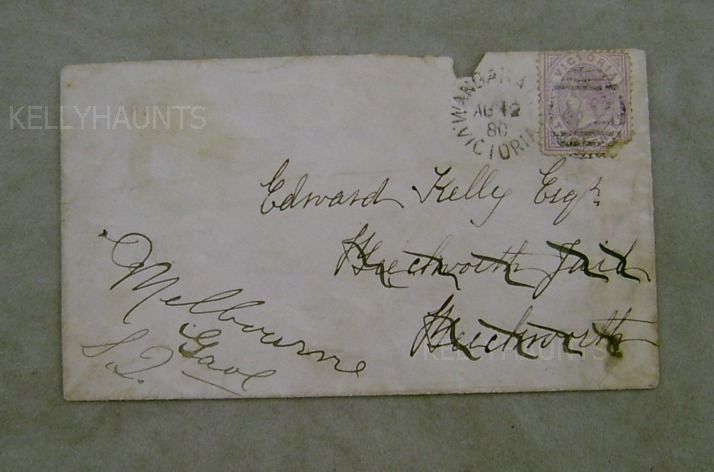 |
| Photo courtesy of Joe Dipisa (www.kellyhauntstours.com.au) |
Thursday, April 7, 2011
Dubious Kelly Relics: Thomas Curnow's Signal Lamp and Ned Kelly's Quill Pen [Sharon Hollingsworth]
(Updated April 8)
There have been many dubious Kelly Gang relics floating around through the years but I have just read about some I had not heard of before.
It seems that Western Australia was rife with relics of the siege as concerns Glenrowan schoolmaster Thomas Curnow and railway guard Frank Bell.
From the Sunday Times of Aug. 31, 1919
"A relic of the Kelly Gang is in Perth in the possession of Actor-Manager Ted Cole. It was given him by Guard Bell in charge of the train the Kellys planned to capsize. The said souvenir is a large red pocket handkerchief used by Schoolmaster Curnow over an ordinary candle lamp to stop the police special."
The article went on to relate how Curnow got a hold of a lamp and covered it with a red handkerchief to stop the train. (Don't worry, I am going to be debunking all this in a second!)
Then we read again in the paper (18 years later) where railway guard (Frank) Bell had passed down a relic to his son, also named Frank Bell who sent a photo of it to his son, also named Frank Bell (!?). What was it? Glad you asked! It was the actual "lamp" used by Curnow to stop the train!
From that same article in the Sunday Times of Oct. 3, 1937, it spoke of train guard Bell:
"..whose quick eye it was that sighted the red handkerchief covered lamp waved by schoolmaster Curnow at Glenrowan and so stopped the train containing about 100 police troopers and their horses.....the historic lamp was souvenired by Bell during the subsequent Battle of Glenrowan."
Then, there was yet another article concerning Curnow...
From the Sunday Times of Aug. 10, 1947 in an article called "W.A. Man's Relic of Kelly Gang's Last Stand" it tells of a 77 yr old man whose family knew Curnow post-Glenrowan. Curnow gave the family a piece of the scarf he used to stop the train which this man still had in his possession. However, this gentleman relates what Curnow told him and his family and much of it was oh-so-wrong or maybe just mis-remembered? Stuff like how Curnow was riding to get a doctor when he saw Dan and Steve forcing railway workers to pull up the line and how he pleaded to be let go and they allowed him to proceed and he then went down the line where he heard the train coming and took off his own scarf and wrapped it around a signal lamp.
Ok, let's break this all down. Even though there was an illustration for contemporary newspapers (as well as reports) of Curnow using a lantern to stop the train, he himself testified that:
"I quietly prepared everything, including the red llama scarf, candle and matches..."
[later after hearing the train coming]
"I immediately caught up the candle, scarf, and matches and ran down the line to meet the train. I ran on until I got to where I could see straight before me some distance along the line, and where those in the train would be able to see the danger signal. I then lit the candle and held it behind the red scarf."
BAM! There it is!!!
If you think about it, it made more sense from a security standpoint to have a candle possibly stuck down in his pocket or carried close to his body while in transit down the railway line rather than running the risk of being caught out carrying even an unlit lamp/lantern by a member of the gang or one of their sympathisers. That (to mix metaphors) would have rung an alarm bell, the gig would have been up, and the hammer would have dropped!
In "Last of the Bushrangers" Superintendent Francis Hare related that:
"It afterwards turned out the man was Mr. Curnow, the local schoolmaster, who, having no lamp by which to stop the train, got a red scarf and held a candle behind it when he heard the train approaching, but, having left his wife alone, he hurried back for fear some of the gang might see him. After the guard of the pilot had related this story to me...."
So we see that there was no lantern or lamp nor red handkerchief. Perhaps the chap with the bit of scarf does (or rather did) have a true relic despite his error filled narrative? Concerning the earlier narrative, there were not 100 police troopers on the special train, there were around a couple dozen people in total on the train including police, black trackers, newspapermen, O'Connor's wife and her sister, plus a civilian volunteer.
Ok, let's pick apart the earlier bit with the W.A. man with the relic. Steve Hart was with the railway workers for the lifting of the rails, Dan was not. Curnow was not on the way to get a doctor in the middle of the night when he met the Kellys. He met them later on in the day while out buggy riding with his family. The doctor part might have come from where Curnow testified about how he wanted to get his wife, baby and sister to safety at his mother-in-law's place after Ned let them leave the Inn but he was worried about the gang checking up on them at his home so he left a note saying his sister was ill and they went for medicine (however his wife was restless and upset so they went back to the house..this was before the stopping of the train). He did not use his own scarf, he used his sister's and we know it was not a signal lamp, it was a candle!
How can they get so much so wrong in these reminiscences?
Talking about getting stuff wrong, read on to the second instance of somewhat dubious relics I am relating here. For that we go back to Victoria.
There was this in the Barrier Miner, July 29, 1924
NED KELLY'S PEN FOUND.
"Workmen engaged in dismantling the interior of the Melbourne Gaol yesterday found enclosed in an envelope a quill pen used by Ned Kelly, the outlaw, before his execution in 1880. On the envelope were the words, "Ned Kelly's pen." The initials of Mr. J. B. Castieau, who was the governor of the gaol at the time, were also on the envelope."
Ok, this is a long shot but is a possibility. But as I note below, Ned was unable to write anything other than signing an X due to his damaged arm, so why would he have a pen?
Then a dozen years later there was another mention of Ned's quill pen in the papers.
In the Sunday Times of May 2, 1937 there was an article entitled Ned Kelly's Quill Pen. In the article it related about publicans, Mr. and Mrs. Muldoon, of a Melbourne tavern who had been offered a relic for sale by Jerry the builder and his brother which was "the pen Ned Kelly wrote his last letter on earth with."
When asked whom Ned wrote to with it the reply was
"Why, to his sainted mother, it was his last message to her who loved him. And everybody knows where he got the ink..."
He went on to say:
"I got the story from an old ex-warden of the gaol. He had part charge of Ned and worked in the quill-pen to help him in sending out a message to his poor lonely widowed mother-away up in the country where Ned was captured."...."Well, then," he continued, handling the relic reverently as if it were a fragment from sacred Jerusalem, or a chip from Caesar's tomb, 'Ned tore a linen pocket from his prison jacket to act as note paper, opened a small vein in his arm and used the blood to write a short message to his mother. That's his own life-blood you see on the quill....."I got to know the son of a long ago prisoner who cleaned the cell out after Ned's execution. He told me how his dad had found the quill-pen in the cell where it had been laid down after the condemned man had written his message. He never thought it of any value till I accidentally heard of it and bought it from him for a mere trifle...."
The tavern owners, convinced it was the real deal, purchased it off him.
Then to everyone's consternation:
"A week later half a dozen elderly Hibernian ladies, excited and fuming, alighted from a Fitzroy tram at the corner nearest to what is left of the old Melbourne Gaol. Each had a Ned Kelly quill-pen, all old and crusted with the bushranger's blood."
These ladies along with a local parish priest traced the seller's lodgings and come to find out he had absconded. The landlady told them that:
"About a fortnight ago, Jerry and his brother had brought home from the Melbourne market a live goose..."
You can guess the rest of the story! The goose was cooked (as were the geese of the gullible buyers!) and the feathers were stripped, and the quills, well, you know what became of those!
Quite a silly tale that should never have been if they knew their Kelly story. Ned was unable to write at all while in gaol, only being able to sign an X due to his injured arm and his mother was in the same gaol with him at the time not up in the Kelly country where he was captured!
In closing, there was this bit re the pen from earlier in the newspaper article that I saved till last:
"It's a wonder the police let him have anything at all," said Mrs. Muldoon, whose opinion of the Law that hanged poor Ned was not of a very complimentary nature.
"They tried not to...They were afraid poison might be worked in so they had a special watch on him day and night. They couldn't even trust the regular warders."
That last bit there is a good segue to my next blog posting entitled "Ned Kelly and Poison Pen Letters?" Stay tuned for that!
There have been many dubious Kelly Gang relics floating around through the years but I have just read about some I had not heard of before.
It seems that Western Australia was rife with relics of the siege as concerns Glenrowan schoolmaster Thomas Curnow and railway guard Frank Bell.
From the Sunday Times of Aug. 31, 1919
"A relic of the Kelly Gang is in Perth in the possession of Actor-Manager Ted Cole. It was given him by Guard Bell in charge of the train the Kellys planned to capsize. The said souvenir is a large red pocket handkerchief used by Schoolmaster Curnow over an ordinary candle lamp to stop the police special."
The article went on to relate how Curnow got a hold of a lamp and covered it with a red handkerchief to stop the train. (Don't worry, I am going to be debunking all this in a second!)
Then we read again in the paper (18 years later) where railway guard (Frank) Bell had passed down a relic to his son, also named Frank Bell who sent a photo of it to his son, also named Frank Bell (!?). What was it? Glad you asked! It was the actual "lamp" used by Curnow to stop the train!
From that same article in the Sunday Times of Oct. 3, 1937, it spoke of train guard Bell:
"..whose quick eye it was that sighted the red handkerchief covered lamp waved by schoolmaster Curnow at Glenrowan and so stopped the train containing about 100 police troopers and their horses.....the historic lamp was souvenired by Bell during the subsequent Battle of Glenrowan."
Then, there was yet another article concerning Curnow...
From the Sunday Times of Aug. 10, 1947 in an article called "W.A. Man's Relic of Kelly Gang's Last Stand" it tells of a 77 yr old man whose family knew Curnow post-Glenrowan. Curnow gave the family a piece of the scarf he used to stop the train which this man still had in his possession. However, this gentleman relates what Curnow told him and his family and much of it was oh-so-wrong or maybe just mis-remembered? Stuff like how Curnow was riding to get a doctor when he saw Dan and Steve forcing railway workers to pull up the line and how he pleaded to be let go and they allowed him to proceed and he then went down the line where he heard the train coming and took off his own scarf and wrapped it around a signal lamp.
Ok, let's break this all down. Even though there was an illustration for contemporary newspapers (as well as reports) of Curnow using a lantern to stop the train, he himself testified that:
"I quietly prepared everything, including the red llama scarf, candle and matches..."
[later after hearing the train coming]
"I immediately caught up the candle, scarf, and matches and ran down the line to meet the train. I ran on until I got to where I could see straight before me some distance along the line, and where those in the train would be able to see the danger signal. I then lit the candle and held it behind the red scarf."
BAM! There it is!!!
If you think about it, it made more sense from a security standpoint to have a candle possibly stuck down in his pocket or carried close to his body while in transit down the railway line rather than running the risk of being caught out carrying even an unlit lamp/lantern by a member of the gang or one of their sympathisers. That (to mix metaphors) would have rung an alarm bell, the gig would have been up, and the hammer would have dropped!
In "Last of the Bushrangers" Superintendent Francis Hare related that:
"It afterwards turned out the man was Mr. Curnow, the local schoolmaster, who, having no lamp by which to stop the train, got a red scarf and held a candle behind it when he heard the train approaching, but, having left his wife alone, he hurried back for fear some of the gang might see him. After the guard of the pilot had related this story to me...."
So we see that there was no lantern or lamp nor red handkerchief. Perhaps the chap with the bit of scarf does (or rather did) have a true relic despite his error filled narrative? Concerning the earlier narrative, there were not 100 police troopers on the special train, there were around a couple dozen people in total on the train including police, black trackers, newspapermen, O'Connor's wife and her sister, plus a civilian volunteer.
Ok, let's pick apart the earlier bit with the W.A. man with the relic. Steve Hart was with the railway workers for the lifting of the rails, Dan was not. Curnow was not on the way to get a doctor in the middle of the night when he met the Kellys. He met them later on in the day while out buggy riding with his family. The doctor part might have come from where Curnow testified about how he wanted to get his wife, baby and sister to safety at his mother-in-law's place after Ned let them leave the Inn but he was worried about the gang checking up on them at his home so he left a note saying his sister was ill and they went for medicine (however his wife was restless and upset so they went back to the house..this was before the stopping of the train). He did not use his own scarf, he used his sister's and we know it was not a signal lamp, it was a candle!
How can they get so much so wrong in these reminiscences?
Talking about getting stuff wrong, read on to the second instance of somewhat dubious relics I am relating here. For that we go back to Victoria.
There was this in the Barrier Miner, July 29, 1924
NED KELLY'S PEN FOUND.
"Workmen engaged in dismantling the interior of the Melbourne Gaol yesterday found enclosed in an envelope a quill pen used by Ned Kelly, the outlaw, before his execution in 1880. On the envelope were the words, "Ned Kelly's pen." The initials of Mr. J. B. Castieau, who was the governor of the gaol at the time, were also on the envelope."
Ok, this is a long shot but is a possibility. But as I note below, Ned was unable to write anything other than signing an X due to his damaged arm, so why would he have a pen?
Then a dozen years later there was another mention of Ned's quill pen in the papers.
In the Sunday Times of May 2, 1937 there was an article entitled Ned Kelly's Quill Pen. In the article it related about publicans, Mr. and Mrs. Muldoon, of a Melbourne tavern who had been offered a relic for sale by Jerry the builder and his brother which was "the pen Ned Kelly wrote his last letter on earth with."
When asked whom Ned wrote to with it the reply was
"Why, to his sainted mother, it was his last message to her who loved him. And everybody knows where he got the ink..."
He went on to say:
"I got the story from an old ex-warden of the gaol. He had part charge of Ned and worked in the quill-pen to help him in sending out a message to his poor lonely widowed mother-away up in the country where Ned was captured."...."Well, then," he continued, handling the relic reverently as if it were a fragment from sacred Jerusalem, or a chip from Caesar's tomb, 'Ned tore a linen pocket from his prison jacket to act as note paper, opened a small vein in his arm and used the blood to write a short message to his mother. That's his own life-blood you see on the quill....."I got to know the son of a long ago prisoner who cleaned the cell out after Ned's execution. He told me how his dad had found the quill-pen in the cell where it had been laid down after the condemned man had written his message. He never thought it of any value till I accidentally heard of it and bought it from him for a mere trifle...."
The tavern owners, convinced it was the real deal, purchased it off him.
Then to everyone's consternation:
"A week later half a dozen elderly Hibernian ladies, excited and fuming, alighted from a Fitzroy tram at the corner nearest to what is left of the old Melbourne Gaol. Each had a Ned Kelly quill-pen, all old and crusted with the bushranger's blood."
These ladies along with a local parish priest traced the seller's lodgings and come to find out he had absconded. The landlady told them that:
"About a fortnight ago, Jerry and his brother had brought home from the Melbourne market a live goose..."
You can guess the rest of the story! The goose was cooked (as were the geese of the gullible buyers!) and the feathers were stripped, and the quills, well, you know what became of those!
Quite a silly tale that should never have been if they knew their Kelly story. Ned was unable to write at all while in gaol, only being able to sign an X due to his injured arm and his mother was in the same gaol with him at the time not up in the Kelly country where he was captured!
In closing, there was this bit re the pen from earlier in the newspaper article that I saved till last:
"It's a wonder the police let him have anything at all," said Mrs. Muldoon, whose opinion of the Law that hanged poor Ned was not of a very complimentary nature.
"They tried not to...They were afraid poison might be worked in so they had a special watch on him day and night. They couldn't even trust the regular warders."
That last bit there is a good segue to my next blog posting entitled "Ned Kelly and Poison Pen Letters?" Stay tuned for that!
Friday, April 1, 2011
Who escorted Mrs. Devine to the Jerilderie courthouse? [Sharon Hollingsworth]
 |
| Mary Devine in later life (courtesy of Trove) |
Just prior to the Kelly Gang's visit Mrs. Devine had a prophetic dream.
According to the West Coast Times of February 27, 1879:
It was half past eleven o'clock, and a clear fine night. Mrs. Devine awoke out of a troubled sleep and told her husband, in a state of alarm, that she had dreamt she had seen the Kellys crawling along the police fence, that he (Devine) and Richards were on the other side and did not know that the Kellys were near them. She imagined that the Kellys were taking aim at her husband and his companion with their firearms, and she was unable to warn them of the danger.
But how were any of them to know that the dream was about to become reality..the Kellys showed up soon after!
At the time of the Kelly Gang's visit Mrs. Devine had three children (according to Corfield) and was pregnant with a fourth.
She was still in her night-gown when Ned Kelly roused her husband and Constable Richards up and then bailed them up. When Ned threatened to shoot Constable Devine (according to Peter Dunne, telegraph operator) "Mrs. Devine, on her knees, begged for him not to do so, and he apparently acceded to her request, saying he would have done so but for her." She was assured that no harm would come to her husband or family if she would not raise the alarm to anyone for the duration of their stay.
She then had to show them around the place so they could confiscate all of the weapons and ammunition. She also prepared food for them at Ned's request.
Constable Devine was worried about Ned "interfering with his wife" and Ned was quite offended and said that he had never offered offense to any woman and that she would be safe.
In Ian Jones's "Ned Kelly: A Short Life" he relates instances of Mrs. Devine's dealings as concerns the Kellys as told in interviews with her granddaughter a century later. One instance was where Ned Kelly himself helped Mrs. Devine to empty a tub of water her children had been bathed in earlier that evening. He said she should not try to do it "in her condition." Jones goes on to relate that Mrs. Devine said of Ned that he was "the kindest man she ever met."
The gang settled in for the night, taking turns sleeping and standing guard.
From Rev Gribble's article in Leisure Time (1895)
During the night it was arranged that the whole company should occupy the parlour of the barracks. The night being excessively hot, the sergeant's wife begged for a breath of air, and, feeling faint, said she should scream if the door was not opened. Steve Hart, raising his revolver at her, threatened to shoot her if she did not keep quiet. She replied, "Little do mothers know what they are rearing their children for!" "I would shoot my own mother," was the savage retort, "if she didn't do as I told her!"
But. I had read elsewhere where she and the children were allowed to sleep in the bedroom apart from the others.
The next morning was Sunday and Mrs. Devine always went over to the courthouse across the road to prepare the place for Mass for the visiting priest (it was on rotation between two priests, Father Slattery and Father Kiely, that particular Sunday was Father Kiely's turn).
Ned decided that she best stick to her routine, as her missing doing her duty there would draw questions and visitors. Here is where it gets sticky. Those who were in Jerilderie and actually knew the parties involved (schoolteacher William Elliott and Rev. Gribble) both avow that it was Dan Kelly who escorted her over and helped her clean up and place flowers. I tend to believe it was Dan. However, there are other reports, red herrings if you will, that throw us off that scent!
Some of the early newspaper articles just say "Kelly" escorted her. I suppose it depends on who read what as to what is told in books. Constable Thomas McIntyre in his narrative has that it was Ned. Hare and Chomley (who most assuredly had read Hare's book) both say it was Joe Byrne who went with her, as did Frank Clune. Ian Jones has that it was Dan Kelly as did Max Brown and John Molony. Very telling that no one ever said it was Steve Hart!
It is astonishing to me what Joseph Ashmead in his account had to say. I can only shake my head in disbelief! He not only has Mrs. Devine being called Mrs. Ryan, but has Ned helping her at the courthouse and then has Ned and Joe attending Mass with her and the other trooper's wife from the police station (remember, Richards was unmarried)! Even more unbelievable, he also had about the time on a ship to London when he met Father O'Dwyer(!!!!) who claimed he was the one who held the service that Sunday in Jerilderie and that he noticed two strong men in the front with the wives of the police that he later realised were Ned Kelly and Joe Byrne! What codswallop and pig-swill! Yet, even a blind hog finds an acorn every now and then, so we should not always (but in this case we can) dismiss Ashmead totally out of hand!
And here is something else as concerns this episode from the Sunday Times (Perth) May 23, 1926 wherein George Devine was being taunted in later years:
"...he got a plentiful though untruthful reminder that Ned Kelly had taken his (Devine's) wife to a ball at Jerilderie and similar yarns more or less mangled, untrue and improbable."
How did a visit to the courthouse to set up for Mass turn into a visit to a gala ball?
That same day, just after lunch time, newspaper editor Samuel Gill (in search of news to print) went by the police station to chat with Constable Devine to see what was going on with the four new recruits seen around town. Mrs Devine cryptically told him "I cannot tell you anything. Run, for your life is in danger!"
That set in motion events that led to him alerting others and them entering the bank as the Kellys were there for the holdup with him narrowly escaping to the chagrin of Ned who wanted Gill to print copies of the Jerilderie letter for him! Whew! As an aside, during the time the Kellys were there Ned Kelly read some of his Jerilderie letter to Mrs. Devine but she could remember none of it two days later.
After the robbery when the gang were ready to leave town they left constables Devine and Richards and two telegraph-men locked up. He gave the key to Mrs. Devine and he told her to not let them out until half past 7 or that he would "burn the house down over her and her children's heads" if she or anyone else let them out before that time. After the Kellys left others rushed over to the police station to free the prisoners but Mrs. Devine steadfastly refused to open the door or give them the key. Her husband and the others had to wait about an hour and a half before the time Ned appointed for them to be released. Of course, she was just protecting her husband as she did not wish for him to pursue the Kellys and possibly get killed. Ned had taken the police horses and all their guns and ammo and even if they could have borrowed some of each by the time they were released the gang were well away.
The Devines stayed on in Jerilderie for a couple of more years, much later they wound up living in West Australia where Mrs. Devine outlived her husband by 6 years dying in September of 1932.
UPDATE- new papers are being added all the time at trove and one from 1926 in which Mrs Devine says it was STEVE HART who escorted her has come online. My goodness! Can it be true? https://trove.nla.gov.au/newspaper/article/83644047
Subscribe to:
Posts (Atom)